Mothers face immediate, but family-size dependent, costs of sons in preindustrial Finland

Mothers face immediate, but family-size dependent, costs of sons in preindustrial Finland
Young, E. A.; van Dorp, L.; Lahdenpera, M.; Lummaa, V.; Dugdale, H.
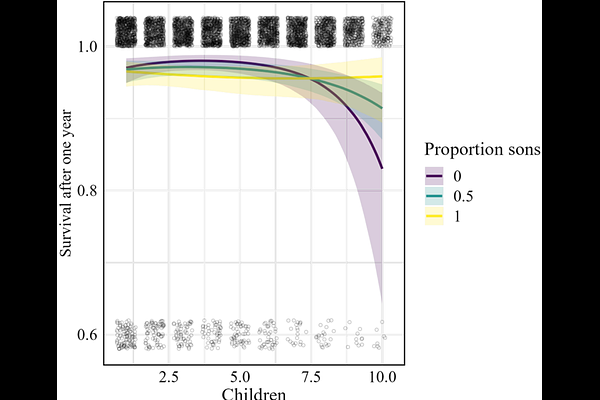
AbstractThe expensive son hypothesis posits that mothers incur higher fitness costs when caring for sons versus daughters in species with male-biased size dimorphism. Evidence for maternal survival costs of sons in humans is limited to shortened overall lifespans; whether having more sons reduces short-term survival during reproductive years is unknown. Here, we utilised life-history data from 5,456 mothers from preindustrial Finland to examine whether mothers with more sons had reduced survival within one year of their last birth. While mothers with few children but more sons showed no differences in survival, at higher family sizes, mothers with more sons had increasingly lower survival. These differences peaked at ~0.4% lower survival per son among mothers with five children, suggesting accumulated physiological costs of sons. These differences then declined and reversed among mothers with more children, potentially due to selective disappearance of frailer mothers. Our results suggest that studies focusing on post-menopausal mothers may bias estimates of the fitness costs of sons and reproductive costs more broadly. We recommend future research further examines the overlooked short-term fitness costs of sons during reproductive years, which is vital for understanding how life-history trade-offs, sexual dimorphism, and their interaction have shaped human evolution.