Identifying and ranking species that need urgent management action to achieve Target 4 of the Global Biodiversity Framework

Identifying and ranking species that need urgent management action to achieve Target 4 of the Global Biodiversity Framework
Akcakaya, H. R.; Mannion, N. L. M.; Morreale, J.; Raimondo, D.; Hoffmann, M.; Butchart, S. H. M.; Mair, L.; Ridley, F.; Rivers, M.; Brant, C.; Clifford, M.; Joyce, M.; Mileham, K.; Felicity, C. N.; Kusrini, M.; Sunarto, S.; Houston, J.; Thomas, N.; Maddock, S. T.; Gonzalez-May, J. F.; Triantis, K.; Vavylis, D.; Spiliopoulou, K.; Gamatis, I. A.; Danmallam, B. A.; Ivande, S. T.; Manu, S. A.; Egbe, S.; Onoja, J. D.; Castellanos-Castro, C.; Lopez-Gallego, C.; Long, B.; McGowan, P. J. K.
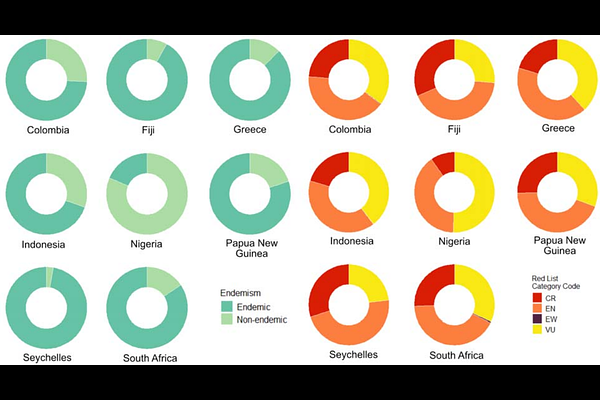
AbstractTarget 4 of the Kunming-Montreal Global Biodiversity Framework (KMGBF) calls for urgent management actions to halt human-induced extinctions and enable species recovery. However, most Parties face substantial challenges in determining which species require urgent management actions. Here, we present a transparent, standardised protocol that identifies and ranks species most likely to need urgent management actions at the national level, using globally available data from the IUCN Red List of Threatened Species. The protocol integrates four criteria aligned with Target 4: global extinction risk, rate of decline, population or range restriction, and endemism, to generate a national ranked list of species. Species scoring highly on these four criteria, and therefore most in need of urgent management action, are ranked most highly. We applied this method to all 250 countries and territories listed in the IUCN Red List and pilot-tested national rankings with participants from eight diverse countries. Across pilots, participants reported that the ranked lists were scientifically robust, time-saving, and valuable starting points for national priority-setting, while stating the importance of national context, and the need for additional technical and financial support for implementation. Our results demonstrate that a science-based approach can meaningfully support Parties in identifying species requiring urgent action under Target 4, in a standardised way. With 2030 approaching rapidly, this protocol provides an immediate, practical tool to accelerate progress toward halting extinctions and advancing species recovery.