Hearing sounds when the eyes move: A case study implicating the tensor tympani in eye movement-related peripheral auditory activity

Hearing sounds when the eyes move: A case study implicating the tensor tympani in eye movement-related peripheral auditory activity
King, C. D.; Zhu, T.; Groh, J. M.
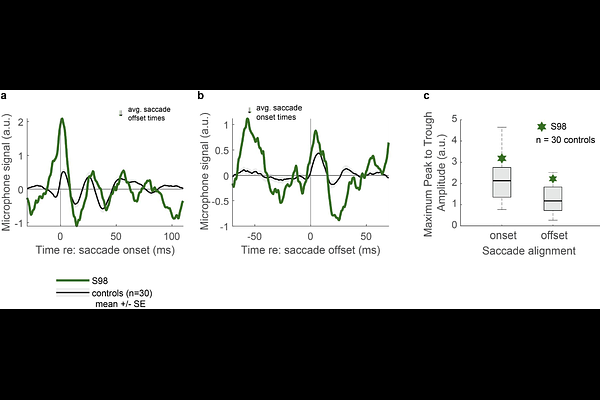
AbstractInformation about eye movements is necessary for linking auditory and visual information across space. Recent work has suggested that such signals are incorporated into processing at the level of the ear itself (Gruters, Murphy et al. 2018). Here we report confirmation that the eye movement signals that reach the ear can produce perceptual consequences, via a case report of an unusual participant with tensor tympani myoclonus who hears sounds when she moves her eyes. The sounds she hears could be recorded with a microphone in the ear in which she hears them (left), and occurred for large leftward eye movements to extreme orbital positions of the eyes. The sounds elicited by this participant's eye movements were reminiscent of eye movement-related eardrum oscillations (EMREOs, (Gruters, Murphy et al. 2018, Broehl and Kayser 2023, King, Lovich et al. 2023, Lovich, King et al. 2023, Lovich, King et al. 2023, Abbasi, King et al. 2025, Sotero Silva, Kayser et al. 2025, King and Groh 2026, Leon, Ramos et al. 2026, Sotero Silva, Broehl et al. 2026)), but were larger and longer lasting than classical EMREOs, helping to explain why they were audible to her. Overall, the observations from this patient help establish that (a) eye movement-related signals specifically reach the tensor tympani muscle and that (b) when there is an abnormality involving that muscle, such signals can lead to actual audible percepts. Given that the tensor tympani contributes to the regulation of sound transmission in the middle ear, these findings support that eye movement signals reaching the ear have functional consequences for auditory perception. The findings also expand the types of medical conditions that produce gaze-evoked tinnitus, to date most commonly observed in connection with acoustic neuromas.