Host-mediated pH influences microbiome assembly and function on the phylloplane

Host-mediated pH influences microbiome assembly and function on the phylloplane
Floc'h, J.-B.; Lopez-Gonzalez, C.; Renner, T.; Gilbert, K. J.
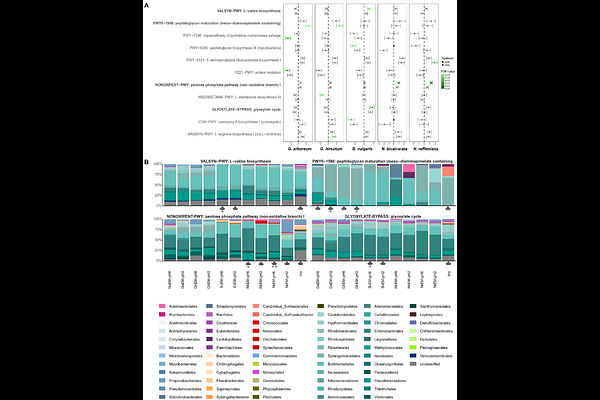
AbstractPlant leaves harbor diverse microbial communities influenced by environmental inputs and host traits, yet it remains unclear whether leaves act as passive substrates or active ecological filters that reorganize microbial functional capacity. Phylloplane pH regulation is one hostplant trait that has been traditionally underexplored. We used metatranscriptomics to examine microbial gene expression on the phylloplane and within whole leaves of five plant species spanning the extremes of baseline phylloplane pH, including hyperalkalinizing Gossypium species, weakly buffering Beta vulgaris, and hyperacidifying Nepenthes species. Young leaves were inoculated with a common soil-derived microbial community to quantify host-associated restructuring of taxonomic and functional profiles, and short-term pH perturbations were applied to test the effect of transient abiotic stress. Across both phylloplane and whole-leaf datasets, host species identity was the primary axis structuring microbial taxonomic composition and expressed functional repertoires. Leaf-associated communities diverged from the source inoculum, but retained a substantial shared functional backbone enriched for central biosynthetic and core metabolic pathways. Host-associated differentiation reflected selective retention and redistribution of reactions within this shared environmental pool rather than acquisition of novel metabolic capacity. Enriched pathway subsets were metabolically coherent and taxonomically distributed across multiple bacterial orders, consistent with functional redundancy and trait-based assembly. Among hosts, Gossypium exhibited the strongest restructuring relative to inoculum, suggesting comparatively stronger host-associated filtering. In contrast, short-term pH manipulation did not induce consistent community-wide functional reorganization. Microbial physiological responses to the phylloplane environment and external pH were observed at the organismal level. Together, these results position leaves as active ecological filters that reorganize microbial functional landscapes through host-specific trait regimes. This work begins to implicate some role of phylloplane pH regulation in microbial assembly and function.