The KPF-SLOPE Survey - Small, Compact Multi-Planet Systems Appear Spin-Orbit Aligned

The KPF-SLOPE Survey - Small, Compact Multi-Planet Systems Appear Spin-Orbit Aligned
Luke B. Handley, Andrew W. Howard, Fei Dai, Ryan A. Rubenzahl, Steven Giacalone, Howard Isaacson, J. M. Joel Ong, Theron W. Carmichael, Yaguang Li, Jack Lubin, Pranav H. Premnath, Claire J. Rogers, Pranav Nagarajan, Gregory J. Gilbert, Benjamin Fulton, Steven R. Gibson, Arpita Roy, Jerry Edelstein, Christopher Smith
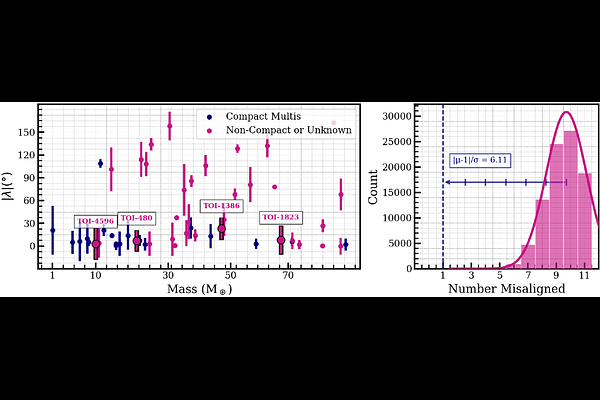
AbstractThe angle between stellar spin axes and planetary orbits -- stellar obliquity -- probes the dynamics of planetary migration and evolution. The obliquities of giant planets have been extensively studied because they are the most easily measured. Smaller planets, while more difficult to measure, have the advantage of better reflecting the dynamics of planetary systems because they trigger negligible back-reactions onto the host star. This paper introduces a new observational campaign called the Small, Low-mass Oblique Planets Experiment (SLOPE) survey with the Keck Planet Finder (KPF) spectrograph, and presents four new obliquity measurements. The SLOPE survey focuses on planets smaller than Saturn across a variety of system architectures. The sky-projected obliquities of the four planets measured -- TOI-1386b, TOI-480b, TOI-4596b, and TOI-1823b -- are all consistent with spin-orbit alignment. We validate the planetary nature of TOI-4596b with a significant obliquity detection. Including these measurements, we conducted a statistical analysis of the obliquities of sub-Saturn size planets in different planetary system architectures. Compared to other architectures, those in compact multi-planet systems reside in orbits that appear preferentially aligned with the stellar equator with 6 sigma confidence.