Solar Orbiter observations of solar energetic electron events associated with hard microflares

Solar Orbiter observations of solar energetic electron events associated with hard microflares
Diane Mittaine, Andrea Francesco Battaglia, Laura Rodríguez-García, Nils Janitzek, Raúl Gómez-Herrero, Francisco Espinosa Lara, Louise Harra
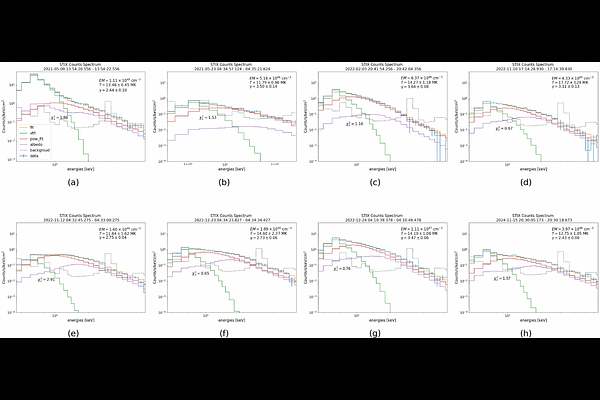
AbstractGenerally, large solar flares accelerate electrons to high energies more efficiently than microflares. However, some microflares, known as hard microflares (HMFs), also produce high-energy electrons, as indicated by their flat hard X-ray (HXR) spectra. These events are typically associated with footpoints located in or at the edge of sunspots. The mechanisms behind this efficient acceleration, and their connection to solar energetic electrons (SEEs), remain unclear. We compare, for the first time, HXR spectra of HMFs with in-situ electron spectra of associated SEEs using Solar Orbiter STIX and EPD observations. This provides insight into acceleration processes and the transport of high-energy electrons into interplanetary space. We identify eight HMFs observed jointly by Solar Orbiter and Earth-based instruments that are associated with SEEs, confirmed through timing and magnetic connectivity analysis. Each event is studied using HXR spectroscopy, SEE velocity-dispersion analysis, and in-situ electron spectral analysis. Seven of eight events show consistent timing between flare HXR emission and inferred electron injection, as well as good agreement with magnetic connectivity estimates. The known correlation between HXR photon and in-situ electron spectral indices extends to HMFs, which occupy the hard end of the distribution, even compared to larger flares. We conclude that HMFs produce prompt SEEs with hard spectra, demonstrating efficient electron acceleration without requiring large flare energy release. Their magnetic configuration, involving open field lines from the sunspot, suggests they may be an important contributor to filling the heliosphere with energetic particles.