Formation of black holes from He stars

Formation of black holes from He stars
Gang Long, Bo Wang, Philipp Podsiadlowski, Dongdong Liu, Yunlang Guo, Shuai Zha, Hanfeng Song, Zhanwen Han
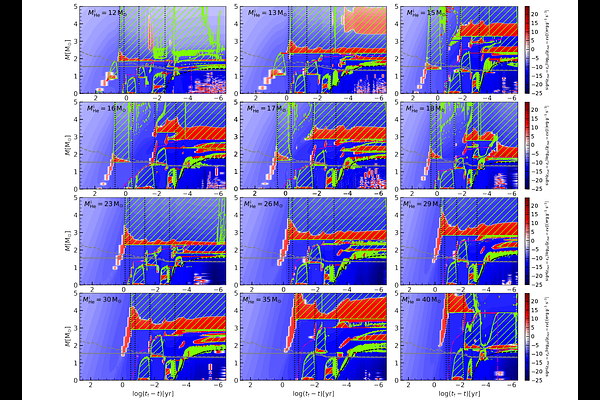
AbstractMassive He stars are potential candidates of type Ib/c supernova (SN) progenitors. Understanding their final fates remains a key issue in astrophysics. In this work, we investigate the evolution of He stars with initial masses from 5 $M_\odot$ to 65 $M_\odot$, focusing on the presupernova (pre-SN) core structures to assess their explodability. Our simulations indicate that the final core structure is determined by the CO core mass and the central 12C mass fraction at the end of core He burning, affecting the properties of central C-burning and the locations of convective shells. The location of the last convective C-burning shell sets the mass of the C-free core, constraining the iron core mass and compactness. We found that the final compactness and iron core mass exhibit non-monotonic behavior with initial mass, suggesting that the boundary between neutron star and black hole formation is not a simple mass threshold. This is due to core C/Ne burning becoming neutrino dominated. This process drives stronger core contraction, ultimately increasing the iron core mass and the final compactness. In contrast, earlier core Ne/O/Si ignition and shell mergers inhibit core contraction, reducing both the iron core mass and final compactness. We also discuss the effects of metallicity and overshooting on the pre-SN core structure. These factors potentially affect the explodability of progenitors.