Characterizing Short-Timescale Optical Variability in Non-blazar Active Galactic Nucleus PKS~0521$-$36 Using TESS

Characterizing Short-Timescale Optical Variability in Non-blazar Active Galactic Nucleus PKS~0521$-$36 Using TESS
Sikandar Akbar, Zahir Shah
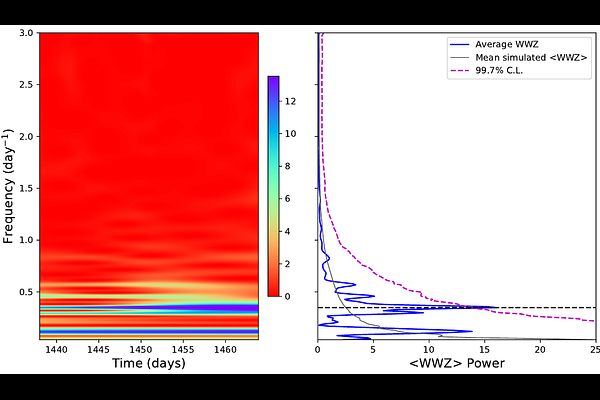
AbstractWe present a systematic analysis of high-cadence optical light curves of the non-blazar AGN PKS~0521$-$36 obtained with \textit{TESS} across three sectors: Sectors~5 and~6 (Cycle~1, 30~min cadence) and Sector~32 (Cycle~3, 10~min cadence). The source exhibits moderate variability with $F_\mathrm{var} \approx 0.69$--$1.19\%$, consistent with a mildly beamed jet. The power spectral density (PSD) in all sectors is better described by a bending power-law than a simple power law, with high-frequency slopes $α_1 \approx 2.1$--2.9, indicating red-noise dominated variability. Flux distributions require two-component models, with a double log-normal providing the best description, suggesting the presence of two distinct optical flux states associated with quiescent jet emission and episodic flaring activity. A significant QPO at $P = 2.838 \pm 0.078$~d is detected in Sector~5 at $>99.99\%$ confidence in the Lomb--Scargle periodogram, independently confirmed by WWZ ($2.839 \pm 0.110$~d) and supported at the $3σ$ level by DRW analysis. The signal spans $\sim$9 cycles within the 26.1-day baseline in Sector~5 and is absent in Sectors~6 and~32, indicating a transient feature. The PSD bending frequency ($ν_b \approx 0.308$~d$^{-1}$; $\sim$3.2~d) is consistent with the QPO period, suggesting a common origin. We interpret the oscillation as magnetohydrodynamic kink instabilities in the relativistic jet, consistent with the observed helicoidal structure. A moderate Doppler factor ($δ\approx 5$--10) naturally explains the day-scale periodicity. Together with previously reported $γ$-ray QPOs on longer timescales, this suggests a hierarchical variability structure, and, to the best of our knowledge, provides the first evidence for an optical QPO in a non-blazar AGN with a directly imaged helical jet.