Potential and limits of the evolutionary rescue of harvested food webs

Potential and limits of the evolutionary rescue of harvested food webs
Villain, T.; Poggiale, J.-C.; Peley, A.; Loeuille, N.
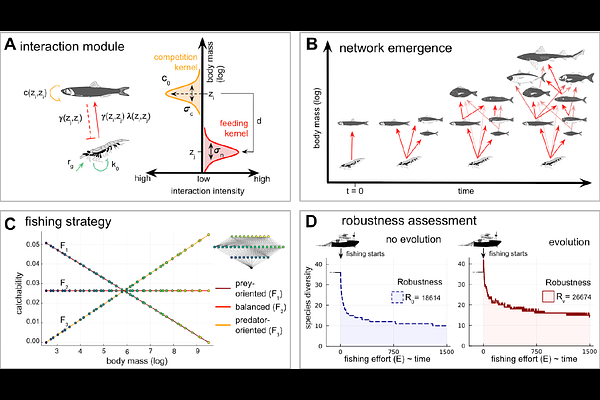
AbstractFishing deeply alters marine food webs structure and can drive the evolution of species traits, whether the species are directly targeted or not. Yet, studies rarely account for fisheries-induced evolution, and consequences are generally interpreted at the single-species level. Theory however predicts that eco-evolutionary dynamics within food webs can either promote biodiversity maintenance or accelerate its decline. In this study, we investigate how evolution affects the robustness of trophic networks under fishing pressure. Modifying evolution speed and the allocation of fishing effort across 458 structurally distinct allometric networks enables us to show that evolution most often enhances robustness. Network evolutionary response however becomes more variable (and possibly negative) as evolutionary rates increase and when fishing preferentially targets predators. By contrast, fishing strategies that concentrate effort on lower trophic levels, or distribute it more evenly, promote network persistence through evolutionary rescue while substantially reducing the risk of evolutionary collapse. Moreover, our results appear to be sensitive to the main forces governing ecological dynamics within the network such as competition or predation intensity. Finally, the consequences of network evolution differ across trophic levels. Evolution often drives the collapse of higher trophic levels while simultaneously promoting evolutionary rescue and enhancing diversity at lower levels through increased diversification, thereby generating a trade-off between vertical diversity (number of trophic levels) and total diversity. This highlights the importance of accounting for evolutionary dynamics and food web functioning in fisheries management, and suggests that reducing predator mortality may help prevent network evolutionary collapse.