Hybrid Simulations of Supersonic Shear Flows: II) Cosmic Ray Viscosity

Hybrid Simulations of Supersonic Shear Flows: II) Cosmic Ray Viscosity
Naixin Liang, Damiano Caprioli
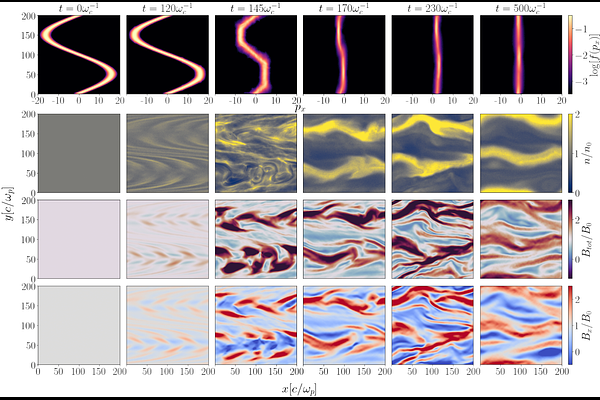
AbstractIn this second paper in a series dedicated to characterizing shear layers via 2D hybrid (kinetic ions -- fluid electrons) simulations, we study the dynamical role of nonthermal particles (cosmic rays, CRs), either spontaneously generated or pre-existing. We initialize Kolmogorov-type sinusoidal velocity shear flows unstable to the Kelvin--Helmholtz instability, which evolve nonlinearly into turbulence. Particles with large gyroradii act as long-range messengers that promote momentum exchange between layers, hence introducing a form of CR viscosity. Even when not energetically dominant, increasing the CR energy density generally enhances momentum transfer, provided that their gyroradii are smaller than the shear lengthscale. We consider flows ranging from subsonic to supersonic and assess the rate of shear dissipation, the partition of the initial kinetic energy among heating, thermal ion acceleration, CR reacceleration, and magnetic-field amplification, and the maximum energy attained by accelerated particles.