Transposable element disruption of a second thyroglobulin-like gene confers Vip3Aa resistance in Helicoverpa armigera

Transposable element disruption of a second thyroglobulin-like gene confers Vip3Aa resistance in Helicoverpa armigera
Bachler, A.; Walsh, T. K.; Andrews, D.; Williams, M.; Tay, W. T.; Gordon, K. H.; James, B.; Fang, C.; Wang, L.; Wu, Y.; Stone, E. A.; Padovan, A.
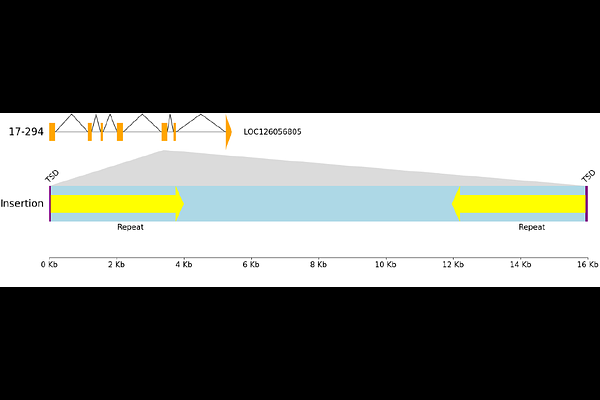
AbstractThe cotton bollworm Helicoverpa armigera is a major global pest controlled by genetically engineered crops expressing Bacillus thuringiensis (Bt) toxins, including Vip3Aa. While Vip3Aa is widely deployed, the genetic basis of resistance remains poorly understood. Previous work identified disruption of a thyroglobulin-like gene (HaVipR1) as one mechanism of resistance, suggesting additional loci may be involved. Results: Using linkage analysis, transcriptomics, long-read sequencing, and CRISPR-Cas9 gene editing, we identify a second thyroglobulin-like gene, HaVipR2, as a novel mediator of Vip3Aa resistance. Resistance in a field-derived H. armigera line was shown to be monogenic, recessive, and autosomal, mapping to chromosome 29. Long-read sequencing revealed a ~16 kb transposable element insertion disrupting HaVipR2, which was undetectable using standard short-read approaches. CRISPR-Cas9 knockout of HaVipR2 conferred >900-fold resistance, confirming its causal role. Comparative analyses show that HaVipR1 and HaVipR2 share conserved domain architecture, indicating that thyroglobulin-domain proteins represent a recurrent target of resistance evolution. Conclusions: Our findings establish thyroglobulin-domain proteins as a new class of Bt resistance genes in Lepidoptera and demonstrate that transposable element insertions can drive adaptive resistance while evading detection by conventional methods. These results highlight the importance of long-read sequencing and accurate genome annotation for resistance monitoring and provide new insights into the molecular basis and evolution of Vip3Aa resistance.