APOSTLE vs. AURIGA Simulations: How Subgrid Models Shape Milky Way Analogs

APOSTLE vs. AURIGA Simulations: How Subgrid Models Shape Milky Way Analogs
Jianhong Hu, Hang Yang, Liang Gao
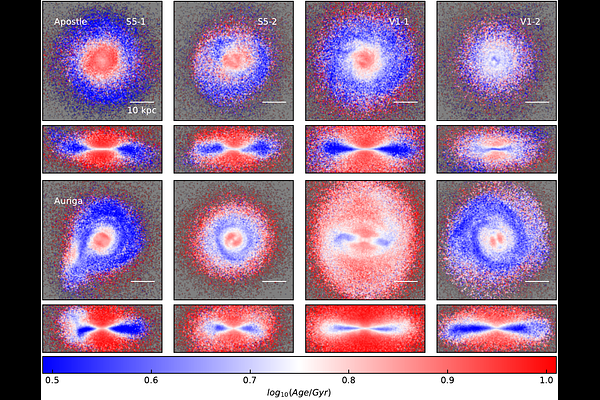
AbstractDespite significant progress in cosmological simulations of galaxy formation, the role of subgrid physics in shaping the detailed properties of galaxies remains incompletely understood. In this work, we analyze two sets of zoom-in simulations that share identical initial conditions but adopt distinct implementations of baryonic physics, enabling a controlled comparison of their predictions. We examine the stellar properties, morphological structures, and satellite populations of the simulated galaxies at $z=0$. We find that AURIGA galaxies systematically exhibit higher stellar masses and surface densities than their APOSTLE counterparts. These differences are primarily driven by variations in the efficiency of gas cooling from the circumgalactic medium (CGM) into the star-forming gas. Both simulations form well-defined disk galaxies; however, AURIGA systems generally display higher disk-to-total mass ratios, earlier disk formation, and more prominent dynamical structures such as bars and spiral arms. Nevertheless, strongly disk-dominated systems are present in both simulations, although they do not arise in the same host haloes. The vertical disk structure in both simulations is well described by a sech density profile, with scale heights below ~ 1 kpc in the inner regions. The satellite populations also differ, with AURIGA producing systematically more massive satellites, including a ~ 0.3 dex increase in the most massive system, while the number of satellites above $10^6 M_{\odot}$ remains comparable in most halo pairs. Both simulations reproduce similar satellite stellar mass--metallicity relations, albeit ~ 0.25 dex higher than observation. This comparative study therefore provides useful benchmarks for future efforts to better constrain galaxy formation models.