Mechanical properties of DNA double-crossover motifs

Mechanical properties of DNA double-crossover motifs
Matouskova, E.; Cuker, M.; Lankas, F.
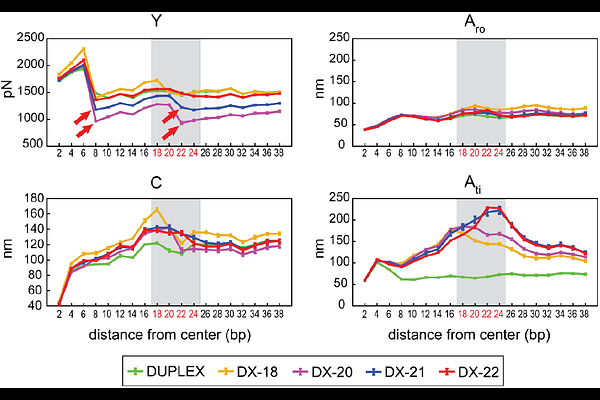
AbstractDNA double-crossover (DX) molecules, comprising two Holliday junctions connected by two duplex arms, are fundamental building blocks of DNA nanostructures, but their mechanical properties remain poorly understood. Here we investigate the elasticity of isolated antiparallel DX motifs with 18 to 22 base pairs between the crossovers. Using mechanical models parameterized by extensive all-atom molecular dynamics simulations, we demonstrate that the bending rigidity of the duplexes within a DX motif is highly anisotropic, and that this anisotropy results from long-range elastic couplings involving all the duplex base pairs between the crossovers. The duplex stretch modulus decreases due to localized defects, while the twist stiffness is close to that of an isolated duplex. The DX core as a whole follows an analytical beam theory in bending but not in torsion. Our results extend beyond local elastic models of DNA nanostructures and pave the way for probing peculiar mechanical properties of other key motifs for DNA and RNA nanotechnology.