DocSeeker: Structured Visual Reasoning with Evidence Grounding for Long Document Understanding

DocSeeker: Structured Visual Reasoning with Evidence Grounding for Long Document Understanding
Hao Yan, Yuliang Liu, Xingchen Liu, Yuyi Zhang, Minghui Liao, Jihao Wu, Wei Chen, Xiang Bai
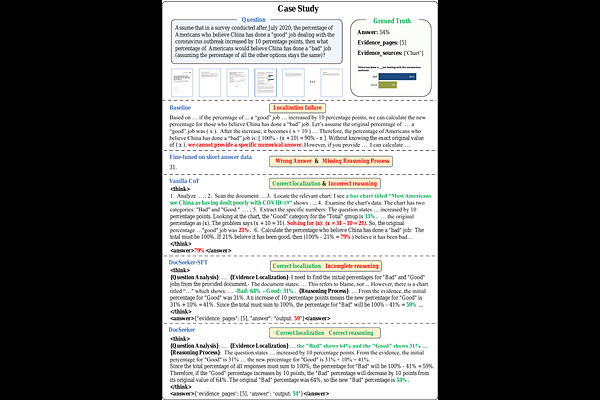
AbstractExisting Multimodal Large Language Models (MLLMs) suffer from significant performance degradation on the long document understanding task as document length increases. This stems from two fundamental challenges: 1) a low Signal-to-Noise Ratio (SNR), with crucial evidence buried in irrelevant pages; and 2) supervision scarcity, as datasets offering only final short answers provide a weak learning signal. In this paper, we address these challenges by proposing a paradigm that requires the model to execute a structured ``\textbf{Analysis}, \textbf{Localization} and \textbf{Reasoning}'' workflow. To instill this capability, we design a two-stage training framework: we first perform Supervised Fine-Tuning on high-quality data generated via an efficient knowledge distillation strategy. Subsequently, we employ an Evidence-aware Group Relative Policy Optimization which jointly optimizes for both evidence localization and answer accuracy. Additionally, we introduce a Evidence-Guided Resolution Allocation strategy to mitigate memory constraints of training on multi-pages documents. Extensive experiments demonstrate that DocSeeker achieves superior performance on both in-domain and out-of-domain tasks. We show it robustly generalizes from short-page training to ultra-long documents and is naturally synergistic with visual Retrieval-Augmented Generation systems, serving as a solid foundation for their implementation.