Observations of highly inclined disks with ALMA. Results from 12CO gas and continuum observations

Observations of highly inclined disks with ALMA. Results from 12CO gas and continuum observations
Laurine Martinien, Gaspard Duchêne, Álvaro Ribas, Marion Villenave, François Ménard, Karl R. Stapelfeldt, Christophe Pinte
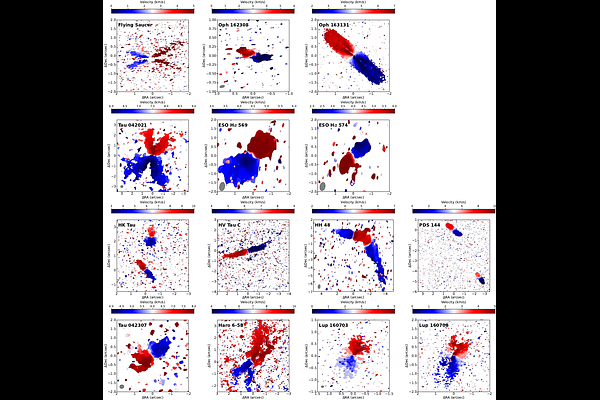
Abstract[Abridged] We aim to study the radial and vertical extents of 12CO gas, millimeter dust thermal emission and optical/NIR scattered light by dust in disks. We analyze a sample of 14 highly inclined protoplanetary disks. We present ALMA high angular resolution band 7 (0.9 mm) continuum images and 12CO (3-2) gas moment maps as well as HST and VLT/SPHERE scattered light images. The majority of disks in our sample (11 out of 14) follow Rgas > Rdust,micron > Rdust,mm. The other 3 disks appear more extended in millimeter continuum than in scattered light. Highly inclined disks tend to appear less radially extended in CO gas line emission than in millimeter dust continuum compared to less inclined disks. This results from optical depth effects and/or radial drift. The known correlation between disk size and millimeter continuum and line fluxes are confirmed in our sample with highly inclined disks significantly fainter than disks seen at lower inclination for a given disk radius. We found that this correlation is significantly tightened once fluxes are corrected for the disk inclination, consistent with the disks being optically thick at millimeter wavelengths. Regarding the vertical extent defined as the apparent emitting height, most disks in our sample follow Hgas > Hdust, mm. This strengthens our previous findings that the millimeter dust is highly decoupled from the gas and forms a layer in the disk midplane due to vertical settling. Most disks appear more vertically extended in gas than in scattered light, suggesting that the micron-sized dust is not fully coupled to the gas. We also estimated dynamical masses using PV diagrams for the first time for most of the objects in our sample. We found an anti-correlation between the dynamical mass and the aspect ratio, emphasizing the dominant role of gravity in setting the disk vertical extent, but no correlation with the disk radius.