Beyond Pulsing Dyes: Are Flickers the Language of the Mitochondrial Network?

Beyond Pulsing Dyes: Are Flickers the Language of the Mitochondrial Network?
Cierco, C.; Santos, F.; Nobrega-Pereira, S.; da Cruz e Silva, O.; Trigo, D.
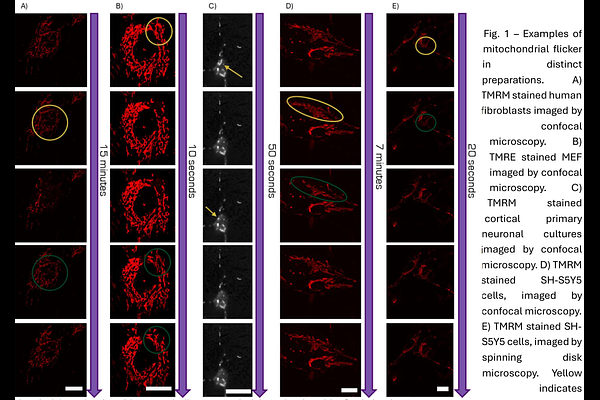
AbstractMitochondrial membrane potential is central to ATP production, ion homeostasis, and cell survival, reflecting the functional state of the inner mitochondrial membrane and oxidative phosphorylation. Accurate assessment of membrane potential is therefore essential for understanding mitochondrial physiology and dysfunction in health, ageing, and disease. Lipophilic cationic fluorescent dyes, such as TMRM and TMRE, are widely used to monitor membrane potential in live cells, enabling high-temporal-resolution imaging of both steady-state membrane potential and dynamic fluctuations. Beyond stable bioenergetic measurements, live-cell imaging reveals transient, reversible depolarisation events, known as mitochondrial 'flickers'. These events, observed across multiple cell types and imaging platforms, are often associated with brief openings of the mitochondrial permeability transition pore (mPTP) and may represent regulated mitochondrial excitability, rather than irreversible damage. While excessive or synchronised depolarisations may signal mitochondrial injury, transient flickers are increasingly viewed as potential signalling mechanisms within the mitochondrial network. This work discusses methodological considerations for membrane potential imaging, the biological significance of mitochondrial flickers, and the importance of distinguishing physiological events from probe- and light-induced artefacts, highlighting the emerging concept of mitochondria as dynamic and communicative bioenergetic networks.