Cosmologically viable non-polynomial quasi-topological gravity: explicit models, $Λ$CDM limit and observational constraints

Cosmologically viable non-polynomial quasi-topological gravity: explicit models, $Λ$CDM limit and observational constraints
Emmanuel N. Saridakis
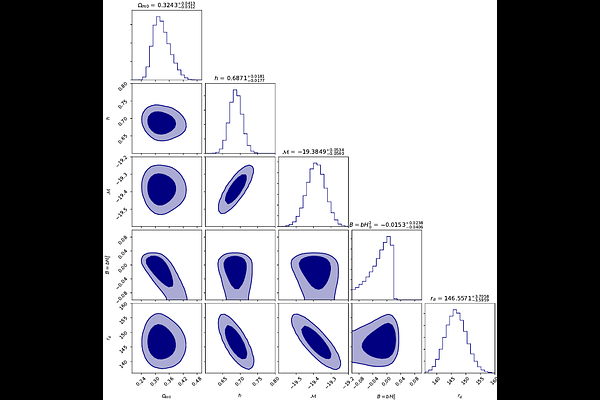
AbstractWe investigate the cosmological implications of non-polynomial quasi-topological gravity (NPQTG), a novel class of modified gravitational theories in which the background dynamics is encoded in a single function of the Hubble parameter. This framework provides a minimal and theoretically consistent extension of general relativity, incorporating higher-curvature effects while preserving second-order field equations and avoiding higher-derivative instabilities. We first establish the general conditions for cosmological viability and construct explicit realizations, including polynomial, quartic, power-law and non-polynomial models, demonstrating how different functional forms lead to distinct expansion histories. Focusing on the quartic and power-law cases, we show that the resulting cosmological evolution reproduces the standard thermal history of the Universe and gives rise to an effective dark-energy sector of geometric origin, with dynamical equation-of-state behavior that can lie in the quintessence or phantom regime. We then confront the models with observational data from Type Ia Supernovae, Cosmic Chronometers, and Baryon Acoustic Oscillations, using a Bayesian MCMC analysis. We find that both models provide an excellent fit to the data, remaining fully compatible with current constraints and statistically competitive with $Λ$CDM. Our results demonstrate that NPQTG offers a simple and efficient framework for describing late-time cosmic acceleration with dynamical dark energy, while maintaining theoretical consistency and observational viability.