Motor Cortical Computations Underlying Natural Dexterous Movement in Freely Flying Bats

Motor Cortical Computations Underlying Natural Dexterous Movement in Freely Flying Bats
Styr, B.; Qi, K.; Chen, X.; Liberti, W.; Yartsev, M.
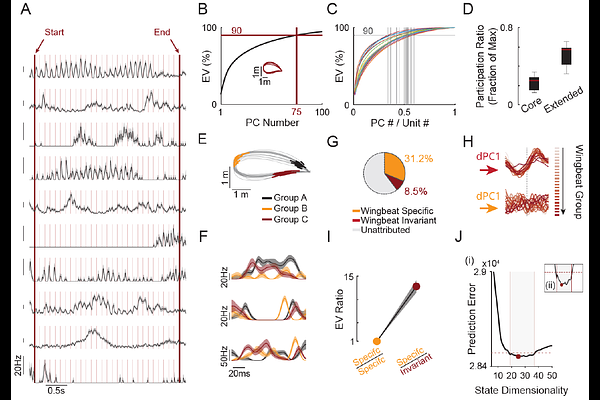
AbstractElucidating the neural computations underlying natural, complex movement remains a fundamental challenge in neuroscience. Bat flight presents a formidable motor control challenge, requiring the use of hand-like wings whose many degrees of freedom must be precisely coordinated to enable rapid three-dimensional maneuvers. Here we performed large-scale wireless recordings of neuronal ensembles from the wing motor cortex of freely flying bats using Neuropixels probes, alongside detailed 3D pose tracking of wing kinematics. Despite the complexity of flight control, bats repeatedly executed highly accurate flights through precise adjustments of individual wingbeats. Surprisingly, motor cortical activity was not dominated by the global wingbeat cycle. Instead, individual neurons were sparsely active, exhibiting mixed selectivity for specific flight kinematics combined with variable entrainment to the wingbeat phase reaching millisecond-scale precision. This yielded a high-dimensional population regime driven by low shared variance across wingbeats, with successive wingbeats occupying distinct neural population states. Our findings reveal that during complex natural behavior the mammalian motor cortex operates in a high-dimensional computational regime that challenges prevailing views of motor cortical computation and underscores the importance of studying ethologically relevant behaviors to uncover neural principles governing brain function