Predictive coding and oscillations underlie the optomotor response in distant insect lineages

Predictive coding and oscillations underlie the optomotor response in distant insect lineages
Dauzere-Peres, O.; de Wever, S.; Wystrach, A.
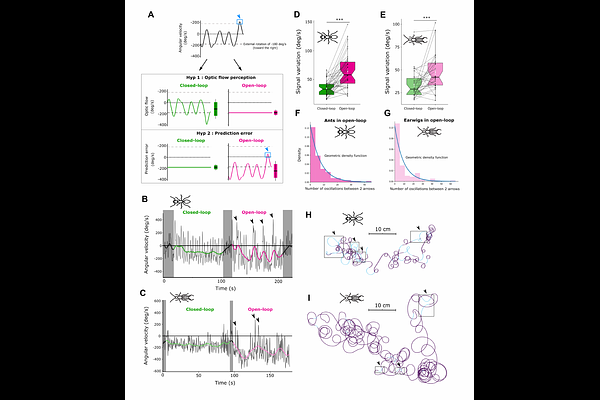
AbstractThe optomotor response (OMR) refers to animals' distinctive turning response to rotating visual stimuli. It is assumed to be a predictable Stimulus-Response (S-R) behavior. Here we show in two phylogenetically and ecologically distant insects (ants and earwigs) that it is not the case. Insects' turning responses were not determined by the detected visual-motion, but by the computation of optic flow prediction errors, which we could infer by manipulating the visual-feedback expected from their own movements. Moreover, both insects displayed regular oscillations of angular velocity, which were modulated by the prediction errors. This produces a closed-loop system yielding complex dynamics and a stochastic moment-to-moment behavior, which can be captured with a simple predictive computational model. We conclude that internal oscillators and predictive coding, as well as their closed-loop interaction, are ancestral features of insect brains conserved across more than 350 million years. The OMR is a by-product of this control system and appears deterministic only when averaging animals' responses.