Connectome lateralization in autism across the first 14 years: heterogeneity related to developmental stage, hemisphere, and pathophysiology

Connectome lateralization in autism across the first 14 years: heterogeneity related to developmental stage, hemisphere, and pathophysiology
Liu, Q.; Li, Q.; Li, X.; Wei, X.; Zhang, X.; Zhou, W.; Zhang, L.; Ren, T.; Huang, C.; Tan, H.; Huang, L.; Liu, K.; Chen, J.; Xu, W.; Zhang, Q.; Kendrick, K. M.; Zhao, W.; Li, F.
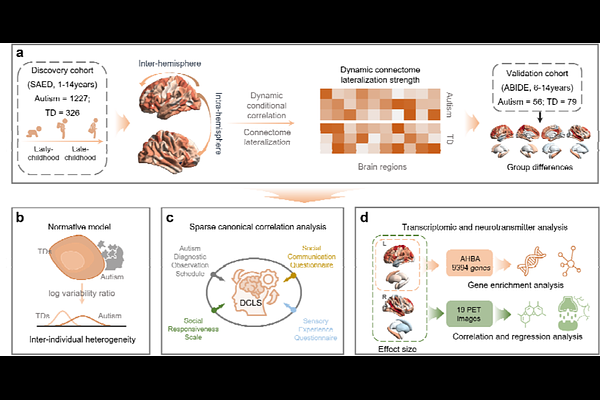
AbstractHemispheric lateralization is fundamental feature to neurodevelopment, yet its dynamic evolution in autism across childhood and underlying molecular mechanisms remain unknown. Thus, using a large-scale resting-state fMRI dataset (n = 1553, ages 1-14), we investigated developmental heterogeneity in connectome lateralization. At the group level, abnormalities in dynamic connectome lateralization strength (DCLS) progressed from focal patterns in early childhood ([≤] 6 years) to widespread distributions by late childhood ([≤] 14 years), independent of symptom severity. The late-stage patterns were validated using the ABIDE dataset (n=153). Late childhood also showed marked increases in inter-individual heterogeneity. These alterations were significantly associated with clinical phenotypes, transcriptomic profiles, and multiple neurotransmitter systems, with distinct patterns across childhood groups. Our findings reveal a developmentally dynamic trajectory of connectome lateralization in autism and highlight late childhood as a critical window for stage- and individual-specific interventions tailored to substantial individual heterogeneity.