Organization of functional brain networks architecture during negative movie watching in late adulthood

Organization of functional brain networks architecture during negative movie watching in late adulthood
Sarebannejad, S.; Ye, S.; Ziaei, M.
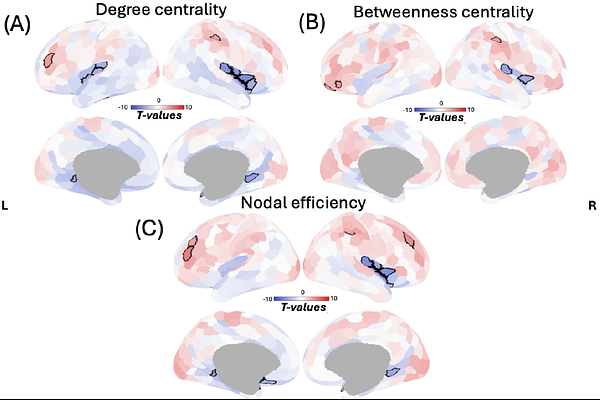
AbstractMost evidence on age-related network topology derives from resting-state paradigms, leaving unclear how aging alters brain organization during naturalistic processing and whether graph-theoretical metrics relate to emotional and cognitive functioning in ecologically valid contexts. We analyzed movie-fMRI and behavioral data from 72 younger and 68 older adults, examining global (small-worldness, clustering coefficient, characteristic path length), network (participation coefficient), and nodal (degree centrality, betweenness centrality, nodal efficiency) properties. Regression models were used to test associations between nodal measures and both the Emotional Resilience Index (ERI) and the Cognitive Function Index (CFI), while mediation analyses were conducted to test whether nodal measures mediate the relationship between age and ERI. Older adults exhibited increased characteristic path length and clustering coefficient, indicating reduced global integration and greater local segregation. Although small-world organization was preserved in two groups, there was less pronounced small-world architecture in older adults compared to younger adults, suggesting a shift toward more regularized, locally clustered networks and reduced long-range connections during dynamic stimuli. Participation coefficient values were higher in the somatomotor, frontoparietal, and default mode networks, and lower in the subcortical network, among older adults reflecting greater between-network integration in cortical networks but diminished subcortical coordination in aging. Five key nodes, two thalamic regions, hippocampus, and two insular regions, showed reduced centrality and efficiency in older adults during the negative movie, indicating weakened dominance of subcortical hubs under emotional salience condition. Right thalamic nodal properties were negatively associated with ERI and CFI and served as mediators in the relationship between age and emotional resilience. These findings suggest that reduced thalamic hub centrality may reflect adaptive recalibration of salience emotional processing, linking network reorganization to improved emotional resilience in aging.