Comparative genomics of Cadophora luteo-olivacea reveals a divergent lineage, conserved functional repertoires, and strain-level variation in pathogenicity

Comparative genomics of Cadophora luteo-olivacea reveals a divergent lineage, conserved functional repertoires, and strain-level variation in pathogenicity
Leal, C.; Bujanda, R.; Eichmeier, A.; Pecenka, J.; Hakalova, E.; Antonielli, L.; Compant, S.; Gramaje, D.
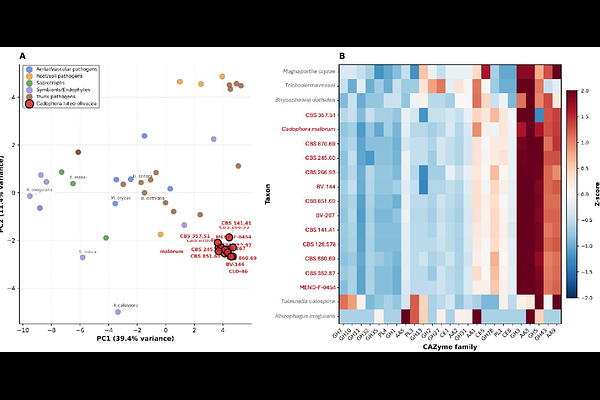
AbstractCadophora luteo-olivacea is an ecologically versatile fungus associated with grapevine trunk diseases, yet the extent to which strains from different hosts and environments differ in genome composition, functional potential, and pathogenicity remains poorly understood. Here, we performed a comparative genomic analysis of 12 C. luteo-olivacea isolates recovered from grapevine, almond, apple, Crocus bulbs, soil, air, wastewater, and deep-sea sediment. Genome assemblies were highly complete (BUSCO >99%) and ranged from 46.94 to 50.70 Mbp. Pairwise average nucleotide identity (ANI) revealed a cohesive 11-strain group and one markedly divergent strain, CBS 266.93. Phylogenomic analysis based on 2,645 single-copy orthologs further showed that CBS 266.93 lies outside the main C. luteo-olivacea clade and forms a sister relationship with Cadophora malorum, indicating that its taxonomic placement warrants reassessment. Across the remaining strains, broad functional conservation was observed, including similar KOG profiles, extensive carbohydrate-active enzyme repertoires (798-849 genes per genome), and abundant biosynthetic gene clusters (26-35 per genome). Transposable element content varied substantially among strains (0.67-4.45% of genome), but this variation did not parallel overall functional profiles. All isolates colonized grapevine leaves in vitro, although lesion severity differed significantly among strains, indicating conserved plant-colonizing capacity with quantitative variation in aggressiveness. Small RNA profiling of inoculated grapevine leaves further revealed isolate-associated differences in host miRNA family expression, particularly for miR398, miR827, and miR156. Together, these results show that most C. luteo-olivacea strains share a conserved genomic framework compatible with plant colonization, while retaining lineage- and strain-level phenotypic and host-associated variation.