Globular cluster abundance patterns inherited from giant molecular clouds

Globular cluster abundance patterns inherited from giant molecular clouds
William McClymont, Vasily Belokurov, Sandro Tacchella, Rahul Kannan, Aaron Smith, Ewald Puchwein, Enrico Garaldi, Mark Vogelsberger, Stephanie Monty, Josh Borrow, Laura Keating, Xuejian Shen, Zihao Wang, Oliver Zier, Changhyun Cho, Yuki Isobe, Xihan Ji, Roberto Maiolino, Giulia Pruto
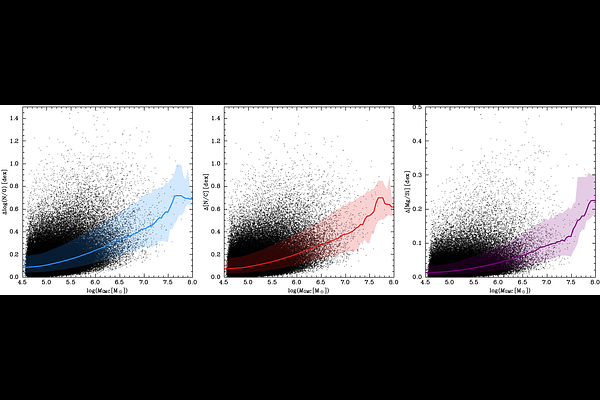
AbstractGlobular clusters exhibit large star-to-star variations and anticorrelations in their light element abundances that are commonly interpreted in terms of in-cluster self-enrichment, in which ejecta from early-forming cluster stars pollute the gas from which later stars form over millions of years. Yet proposed self-enrichment scenarios suffer from a severe mass-budget problem or invoke exotic stellar populations. Using cosmological radiation-hydrodynamic simulations with a standard chemical enrichment model, we identify a population of giant molecular clouds whose internal abundance patterns reproduce several key globular cluster signatures: large light-element abundance spreads and nitrogen-oxygen anticorrelations at nearly constant iron abundance. These clouds form at the restart of star-formation activity after an earlier starburst, where previously ejected oxygen-rich gas collides with nitrogen-rich galactic gas, and are sites of dense star-cluster formation. In this picture, the chemical abundance patterns of globular clusters need not require extended in-cluster star formation, but can be inherited at birth from chemically structured interstellar gas shaped by the baryon cycle. Globular clusters therefore provide a fossil record of chemical enrichment and gas flows in high-redshift galaxies.