Road proximity differentially shapes rodent-mediated seed dispersal frequency and distance

Road proximity differentially shapes rodent-mediated seed dispersal frequency and distance
Craveiro, J.; Bugalho, M.; Vaz, P. G.
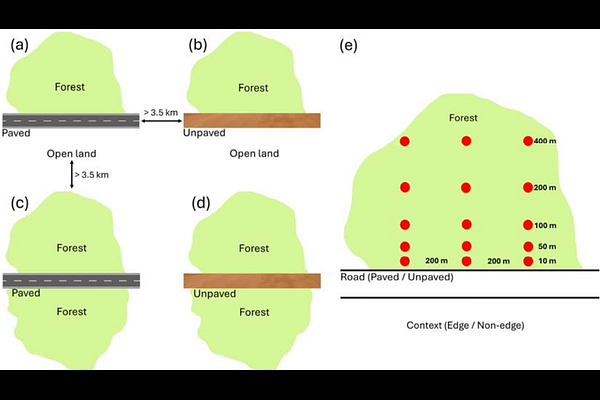
AbstractBy concentrating rodents along verges, roads can reshape rodent-mediated seed dispersal, yet empirical tests remain scarce. We conducted a two-year field experiment in Mediterranean oak woodlands in southern Portugal to test how seed dispersal varies with distance from roads across road type (paved vs. unpaved) and road-forest context (edge vs. non-edge). We tracked labeled holm oak acorns, recording dispersal distances and the number of dispersal events. The two metrics responded differently to road distance. Dispersal distances changed little with distance from roads in non-edge contexts but increased in edge road-forest contexts (2x longer at 400 m than at 10 m) and showed a year x distance-to-road interaction, with longer dispersal distances farther from roads in the second year (a poor mast year). Dispersal distances were also longer when acorns were deposited under shrubs and in areas of higher tree density, and decreased with greater natural acorn availability. In contrast, the number of dispersal events declined with distance from roads (30% more events at 10 m than at 400 m) and was higher along unpaved than paved roads (39% more events). Dispersal frequency also increased in the poor mast year and with shrub cover. No acorns crossed the road. Thus, road verges can concentrate rodent seed handling but do not increase dispersal distances near roads nor provide cross-road seed connectivity; instead, dispersal outcomes depend on edge context, road type, and microhabitat structure. Management that retains structural cover at verges and the adjacent forest edge (e.g., shrub patches and non-uniform clearing) can harness verge-associated activity to increase acorn deposition in sheltered microsites and promote regeneration farther into forest interiors in roaded landscapes.