A hierarchy of locomotion costs shapes optimal foraging strategy

A hierarchy of locomotion costs shapes optimal foraging strategy
Ilett, T. P.; Yuval, O.; Saldelder, F.; Holbrook, R. I.; Hogg, D. C.; Ranner, T.; Cohen, N.
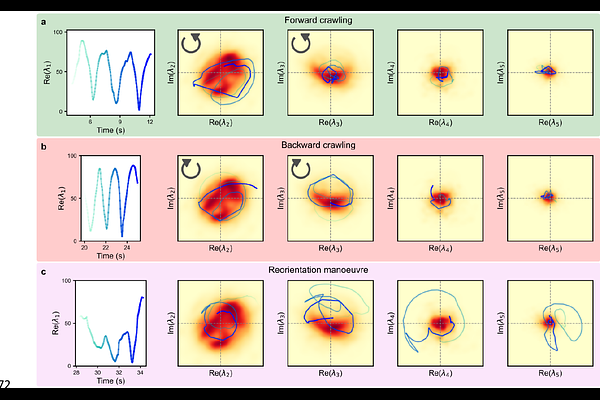
AbstractAnimals must make decisions about how to move through their environment to find food, shelter and mates, yet the general principles underpinning effective search strategies remain poorly understood. Exploration patterns, such as alternating intensive local search with long-range relocation, are observed across many species, but whether these reflect universal organising principles, or are simply imposed by structured environments, is an open question. Here, we reconstruct hours of Caenorhabditis elegans foraging in homogeneous three-dimensional volumes and show that this animal achieves optimal volumetric coverage using a hierarchical search strategy of quasi-planar locomotion patches punctuated by costlier volumetric reorientations. We propose that underlying this cost hierarchy is the worm's highly-constrained shape-space and show that despite being spanned by only five body-posture modes, it gives rise to effective locomotion, combining non-planar gaits, planar turns and three-dimensional reorientation manoeuvres. Our finding that action frequencies decay with inferred cost in a Boltzmann-like distribution is consistent with the Principle of Maximum Entropy: optimal search emerging from the tendency to maximise information gained subject to embodied constraints. This general principle offers a unifying framework to assess the optimality of animal decision-making, with implications for understanding nervous system function, foraging ecology, and the physics of living active matter.