Emergent frequency-dependent selection predicts mutation outcomes in complex ecological communities

Emergent frequency-dependent selection predicts mutation outcomes in complex ecological communities
Li, S. Y.; Feng, Z.; Goyal, A.; Mehta, P.
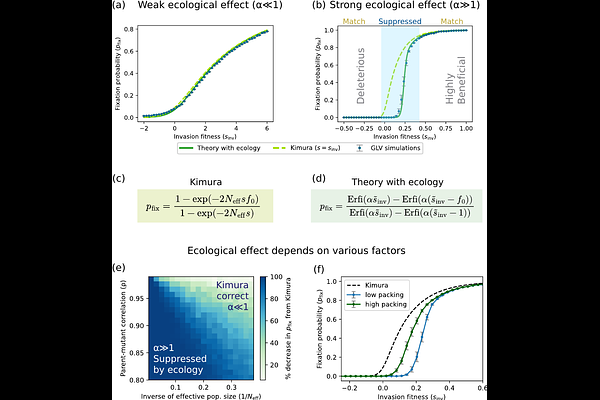
AbstractEcological interactions can dramatically alter evolutionary outcomes in complex communities. Yet, the framework of population genetics largely neglects interactions from a species-rich community. Here, we bridge this gap by using dynamical mean-field theory to integrate community ecology into classical population genetics models. We show that ecological interactions result in emergent frequency-dependent selection between parents and mutants, characterized by a single parameter measuring the strength of ecological feedbacks. This result generalizes classical population genetics models to highly diverse communities and enables predictions of mutation outcomes in these eco-evolutionary settings. We derive an analytic expression for fixation probability that extends Kimura's formula and reveals that ecological interactions strongly suppress the fixation of moderately beneficial mutations. This suppression arises because frequency-dependent selection leads to prolonged coexistence between parent and mutant lineages, which acts as a barrier to fixation. The strength of these effects increases with effective population size and the number of open niches in the ecosystem. Our study establishes a framework for integrating ecological interactions into population genetics, showing that evolutionary outcomes can be predicted using simple models even in the presence of complex community feedbacks.