Selective Stabilization of HRAS2 i-Motif DNA by TMPyP4: A Multimodal Biophysical and Thermodynamic Investigation

Selective Stabilization of HRAS2 i-Motif DNA by TMPyP4: A Multimodal Biophysical and Thermodynamic Investigation
Bag, S.; Ghosal, S.; Burman, M. D.; Chorell, E.; Bhowmik, S.
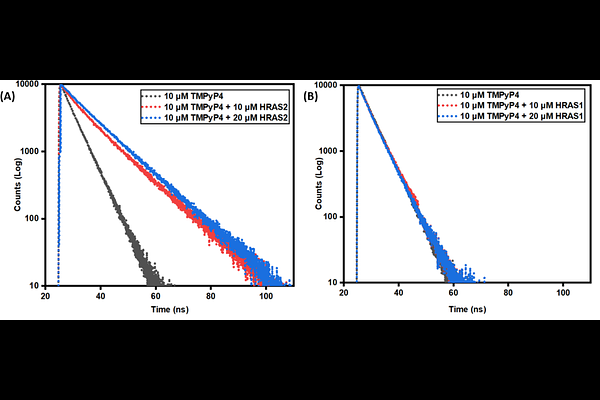
AbstractI-motif (iM) DNA structures, formed by cytosine-rich sequences, are increasingly acknowledged for their involvement in gene regulation, maintenance of genomic stability, and their emerging potential as therapeutic targets, particularly in cancer. Despite their biological relevance, the discovery of selective small-molecule probes that can specifically recognize and interact with iM DNA remains an ongoing challenge. In this study, we have used TMPyP4 and screened for its ability to bind various iM DNA constructs, including HRAS1, HRAS2, VEGF, CMYC, CKIT and H-Telo. Structure-activity relationship analyses revealed that specific substitution patterns conferred selectivity towards HRAS2 iM target. Comprehensive spectroscopic investigations, including UV-Vis absorption, steady-state and time-resolved fluorescence, and fluorescence anisotropy, uncovered key photophysical signatures of binding, including significant hypochromic and bathochromic shifts, enhanced fluorescence emission, and prolonged fluorescence lifetimes. Circular dichroism (CD),thermal denaturation (UV-melting) and thermodynamic investigations confirmed that TMPyP4 effectively stabilized the HRAS2 iM structures without disrupting their native topologies. Meanwhile, FT-IR spectroscopy revealed local structural rearrangements upon TMPyP4 binding, offering further evidence of molecular interaction. Collectively, these findings provide valuable insights into the molecular recognition of iM DNA by TMPyP4 and highlight its promise as both selective HRAS2 iM-binding agent and responsive fluorescent probe. This work lays a strong foundation for the development of novel tools for studying iM structures in biological systems and for designing future therapeutics targeting iM DNA in cancer and related diseases.