ZIMPOL detects scattering polarization in He I D$_3$ during a solar flare

ZIMPOL detects scattering polarization in He I D$_3$ during a solar flare
Francesco Vitali, Andrea Francesco Battaglia, Luca Belluzzi, Svetlana Berdyugina, Renzo Ramelli, Jiří Štěpán, Gioele Janett, Fabio Riva
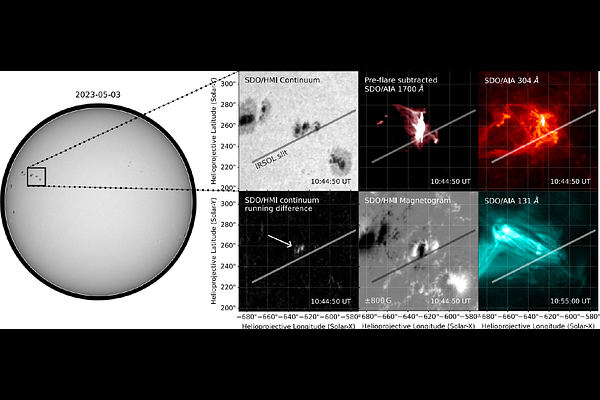
AbstractSpectropolarimetric observations of solar flares in the He I D$_3$ line at 5876 Å are extremely rare, and their diagnostic potential remains largely unexplored. We report the first unambiguous detection of linear polarization in He I D$_3$ during a solar flare. Using the high-precision ZIMPOL polarimeter at the IRSOL observatory in Locarno (Switzerland), we tracked the temporal evolution of the He I D$_3$ Stokes profiles throughout the M7 GOES-class flare that occurred on 3 May 2023 at 10:45 UT. We analyzed the time evolution of the maximum in linear polarization and the absorption depth of the intensity profile. Both the fractional linear polarization, which peaks at $6\times10^{-4}$, and the absorption depth increase rapidly before gradually decaying, with their maxima occurring approximately 5 minutes after the peaks in GOES X-ray flux and SDO/AIA 304 Å emission. From the evolving He I D$_3$ core position, we also derived the temporal evolution of the plasma bulk velocities. The intensity profiles exhibiting strong absorption seems to originate from the flare ribbons. The time evolution of all Stokes parameters in the 3 May 2023 event was driven by changes in ortho-helium density prompted by the different phases of the flare. Our analysis suggests that the observed He I D$_3$ linear polarization is likely not dominated by the theorized impact polarization, as it exhibits neither spatial correspondence with electron precipitation sites nor temporal synchronization with the impulsive phase. Instead, the signals are consistent with scattering polarization produced by anisotropic radiation pumping. We conclude that scattering polarization signal on the order of $0.01\%$ can be produced in the He I D$_3$ line during solar flares. This can provide constraints for flare models.