Recent Adversity Shapes Autonomic and Neural Threat Learning and Retrieval Under Imminent Threat: A Prospective Longitudinal Study

Recent Adversity Shapes Autonomic and Neural Threat Learning and Retrieval Under Imminent Threat: A Prospective Longitudinal Study
Klingelhoefer-Jens, M.; Kuhn, M.; Sommer, T.; Lonsdorf, T. B.
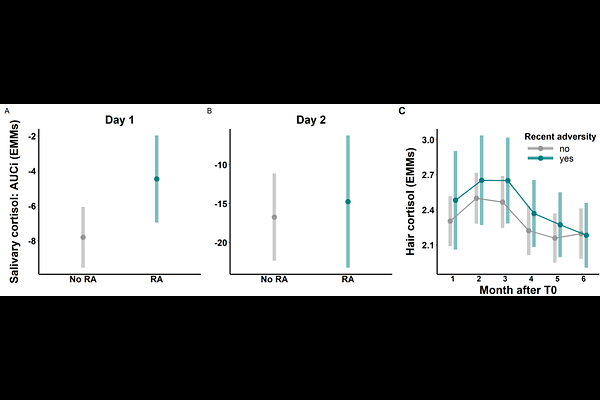
AbstractRecent adversity (RA) increases the risk of later mental health problems, but the mechanisms underlying this association remain largely unclear. Altered associative learning and specifically threat learning processes may constitute a potential pathway. Cross-sectional studies link RA to reduced threat-safety discrimination, a process crucial for adaptive functioning; however, longitudinal evidence allowing for more causal conclusions is lacking. In this prospective longitudinal study, 69 healthy participants completed fear acquisition, 24h-delayed extinction training and a reinstatement-test at two measurement time points six months apart (T0 and T1). We captured exposure to RA between T0 and T1 as well as autonomic and neural responses (SCRs and BOLD-fMRI), fear ratings, and salivary and hair cortisol at both assessments. During acquisition training, at the beginning of extinction (i.e., fear recall) and reinstatement-test at T1, RA-exposed individuals showed less autonomic threat-safety discrimination than unexposed individuals, mainly driven by blunted threat signal responding. These group differences predicted depression levels at the 1 and 1.5 year follow-ups and were mirrored by distinct activation in key fear-related brain regions, including striatal regions, thalamus, vmPFC, insula, and amygdala, whereas self-reported fear was unrelated to RA. In conclusion, across multiple outcomes, RA shapes threat learning and retrieval under conditions of (potential) imminent threat, with reduced autonomic threat discrimination prospectively predicting elevated depressive symptoms at 1- and 1.5-year follow-up. Overall, these findings implicate altered threat learning and retrieval processes as a potential mechanistic pathway through which RA becomes biologically embedded, potentially elevating psychopathological risk.