Extended coronal line emission and new clues to a possible dual AGN in the merger J1356+1026

Extended coronal line emission and new clues to a possible dual AGN in the merger J1356+1026
M. Bianchin, C. Ramos Almeida, O. González-Martín, M. V. Zanchettin, M. Carneiro, M. Pereira-Santaella, C. Tadhunter, G. Speranza, I. García-Bernete, A. Audibert, A. Alonso-Herrero, D. Rigopoulou, A. Labiano, J. A. Acosta-Pulido, S. García-Burillo
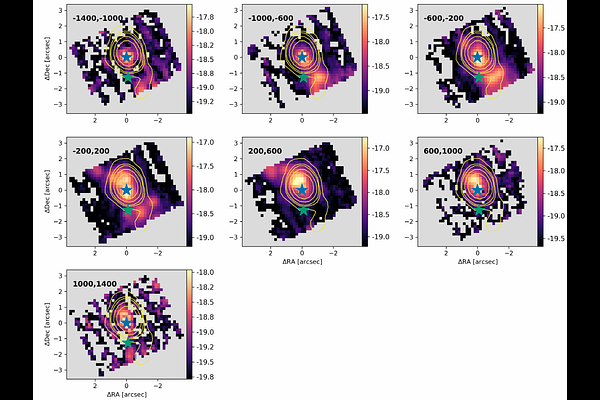
AbstractMerging luminous galaxies are ideal laboratories to study some of the most extreme astrophysical phenomena. The local (z=0.1232) obscured quasar J1356+1026 has two nuclei, North and South (J1356N and J1356S), but despite numerous efforts, J1356S had not yet been confirmed as an AGN. Thanks to the superb sensitivity and spatial resolution of the MIRI/MRS instrument on board the JWST, we present new evidence suggesting that J1356S may indeed host an AGN with log L$_{\rm bol}=43.4\pm^{0.6}_{0.5} erg s^{-1}$. This is supported by the detection of strong coronal line emission at this location and by a spectral shape that differs from that of J1356N and those of the narrow-line region (NLR). Aided by the spatially resolved information of MIRI/MRS and VLT/SINFONI, we also find that the high ionization gas, traced by the coronal lines [Ne V]$14.3~μ$m and [Si VI]$1.963 μ$m, has an extension of ~13-15.5 kpc. This is likely a lower limit of the true extension, as suggested by the comparison with optical imaging from HST. {The extended [Ne V] emission can be accounted for by photoionization from the quasar in J1356N in a relatively low density environment, ranging from $\rm n_e\leq 2000-3800 cm^{-3}$ in J1356N and $\rm n_e\leq 600-1200 cm^{-3}$ in J1356S and the NLR, as measured from the [Ne V]$14.3μ$m and $24.3~μ$m lines.