Ancient Ryukyu Jomon contributed to past and current genetic structure of Japanese populations

Ancient Ryukyu Jomon contributed to past and current genetic structure of Japanese populations
Matsunami, M.; Kawai, Y.; Speidel, L.; Koganebuchi, K.; Takigami, M.; Kakuda, T.; Adachi, N.; Kameda, Y.; Katagiri, C.; Shinzato, T.; Shinzato, A.; Takenaka, M.; Doi, N.; NCBN Controls WGS Consortium, ; Bird, N.; Hellenthal, G.; Yoneda, M.; Omori, T.; Ozaki, H.; Sakamoto, M.; Kinoshita, N.; Imamura, M.; Maeda, S.; Shinoda, K.-i.; Kanzawa-Kiriyama, H.; Kimura, R.
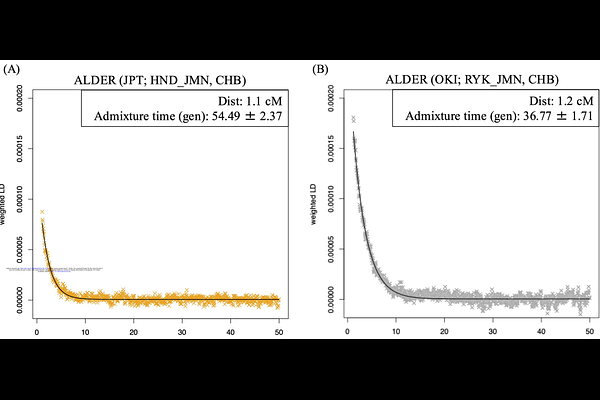
AbstractCharacterized by the earliest use of pottery, the Jomon culture was a unique Neolithic culture that spread throughout the Japanese Archipelago. Previous archaeological evidence suggests that Jomon hunter-gatherers colonized the southernmost islands, the Ryukyu Archipelago, by approximately 7,000 years before present (YBP). However, genetic characteristics of the Ryukyu Jomon population and its contribution to the modern population have not been elucidated yet. In this study, we newly sequenced 273 modern and 25 ancient (6,700-900 YBP) whole genomes collected across the Ryukyu Archipelago. Our analysis demonstrated a genetic differentiation between the Hondo (Japanese mainland) and Ryukyu Jomon, dating back to ~6,900 YBP. After the divergence from the Hondo Jomon, the Ryukyu Jomon experienced severe bottlenecks, with an effective population size of ~2,000. Admixture between the Ryukyu Jomon and migrants from the historic Hondo population occurred ~1,000 YBP, which corresponds to the widespread adoption of iron tools and agriculture in the Central Ryukyus. Different demographic histories between modern Hondo and Ryukyu populations resulted in different rates of Jomon ancestry in these populations. By providing a new perspective on the peopling of the Ryukyu Archipelago, this study significantly enhances our understanding of cultural transitions in the region.