Coherent Signal Detection with Pruning -- I. Finding Short-Period Binary Pulsars in Circular Orbits

Coherent Signal Detection with Pruning -- I. Finding Short-Period Binary Pulsars in Circular Orbits
Pravir Kumar, Barak Zackay
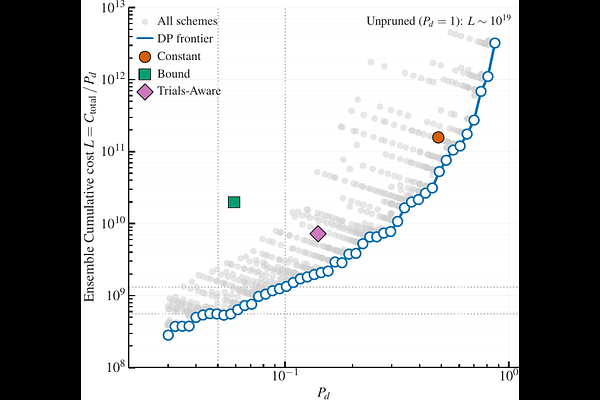
AbstractDetecting pulsars in short-period binary systems, which are unparalleled laboratories for fundamental physics and tests of general relativity, is a prime objective of radio astronomy. Their rapid orbital motion, however, presents a formidable computational challenge. Conventional searches are therefore limited to simplified signal models (e.g., constant acceleration) that remain valid for only short integrations ($\lesssim 4$-$10$% of an orbital period). This fundamental limitation severely degrades search sensitivity, placing much of the faint, relativistic pulsar population beyond the reach of current surveys. We present a novel hierarchical search framework based on extreme pruning that overcomes these limitations by progressively eliminating improbable regions of parameter space across successive coherent integration stages. The algorithm achieves $>90$% detection probability at the sensitivity threshold, with near-unity recovery for stronger signals, while reducing the computational complexity of full circular-orbit searches by up to 10 orders of magnitude relative to an unpruned hierarchical baseline. The resulting efficiency enables, for the first time, fully coherent integration over an entire orbital period and beyond. Compared to conventional acceleration searches, the proposed method delivers a 3- to 5-fold improvement in sensitivity, dramatically increasing the discovery potential for high-value targets such as pulsar-black hole binaries.