Genomebook: Mendelian inheritance as a structured parameterisation layer for LLM agent populations

Genomebook: Mendelian inheritance as a structured parameterisation layer for LLM agent populations
Corpas, M.
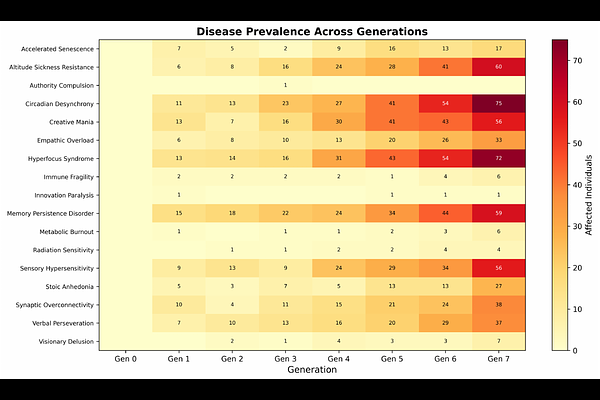
AbstractLarge language model (LLM) agents are typically deployed as clones with no mechanism for heritable variation. Here we introduce Genomebook, a designed evolutionary system encoding 26 behavioural traits across 60 diploid loci using additive, dominant and recessive inheritance models. Twenty founder agents reproduce sexually via Mendelian segregation with de novo mutation. A registry of 20 synthetic conditions with defined penetrance and fitness costs introduces selective pressure. Over eight generations (626 agents, 792 social network posts), trait trajectories are consistent with encoded selection rules: leadership rose from 0.525 to 0.710 under dominant inheritance, obsessive focus fell from 0.775 to 0.601 under fitness cost penalisation. Replicated simulations (20 independent runs across three conditions) confirm that genetic architecture is required for the observed dynamics; a non-genetic baseline produces flat trajectories converging to population means. These results establish genetic architecture as a structured, auditable and heritable parameterisation layer for LLM agent behaviour.