High-S/N Quasar Observations with HST/COS: Deep Fields for Spectroscopy

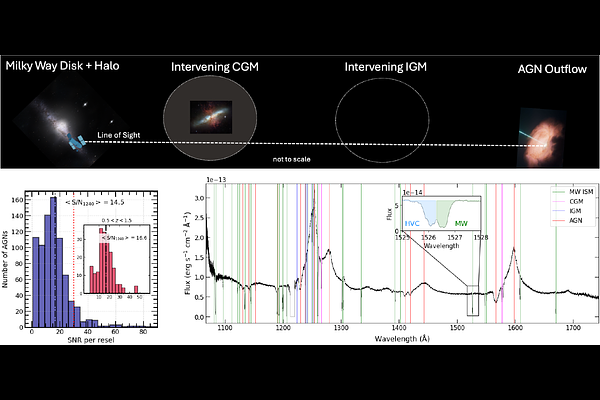
High-S/N Quasar Observations with HST/COS: Deep Fields for Spectroscopy
Andrew J. Fox, Jerry Kriss, Philipp Richter, J. Michael Shull, Frances Cashman, Sapna Mishra, Annelia Anderson, Nahum Arav, Ramona Augustin, Kathleen Barger, Michelle Berg, Rongmon Bordoloi, Sanchayeeta Borthakur, Joseph Burchett, Jane Charlton, Hsiao-Wen Chen, Christopher Churchill, Ryan Cooke, Annalisa de Cia, Gisella de Rosa, Romeel Davé, Yakov Faerman, Travis Fischer, David French, Farhan Hasan, Svea Hernandez, Cameron Hummels, Sean Johnson, Glenn Kacprzak, Vikram Khaire, Doyeon Avery Kim, Brad Koplitz, Varsha Kulkarni, Nicolas Lehner, Matilde Mingozzi, Talawanda Monroe, Sowgat Muzahid, Benjamin Oppenheimer, Molly Peeples, Céline Péroux, Patrick Petitjean, Andreea Petric, Max Pettini, Zhijie Qu, Kate Rowlands, Ravi Sankrit, Debopam Som, Raghunathan Srianand, Nicolas Tejos, Jason Tumlinson, Bart Wakker, Jessica Werk
AbstractHubble is still in prime observing condition for making transformative discoveries in UV astronomy. In this white paper we describe the science case for a deep (S/N>30) UV spectroscopic survey with HST/COS targeting approximately 20 QSOs at 0.5<z<1.5 at good resolution (20 km/s). This survey would capitalize on our current UV capability, produce a legacy dataset enabling community science in many areas of galactic and extragalactic research, and pioneer a path for future UV science with the Habitable Worlds Observatory. Such high-S/N spectra are largely missing from the MAST archives, and would be analogous to the deep Hubble imaging fields (HDF, UDF, Frontier Fields) that have been enormously successful and far-reaching in their science impact. This legacy dataset would enable frontier science programs in several areas, including (1) studies of the CGM and IGM at unparalleled sensitivity, covering a wide range of UV metal lines and reaching very low H I column densities of log N=12.6 and low metallicities near [Z/H]=-2, enabling precision studies of the chemical abundances, ionization, temperature, and baryon and metal budgets of the CGM and IGM; (2) diffuse gas in the Milky Way and Local Group, including high-velocity clouds and gas streams from satellite mergers; (3) AGN outflows, which would be probed in the rest-frame extreme ultraviolet (EUV), covering continuum-generation mechanisms and diagnostics of gas in accretion-disk outflows.