The spectrum of the persistent radio source associated with FRB 20190417A

The spectrum of the persistent radio source associated with FRB 20190417A
L. Bruno, D. Pelliciari, G. Bernardi, M. Pilia, L. Beduzzi, P. Esposito
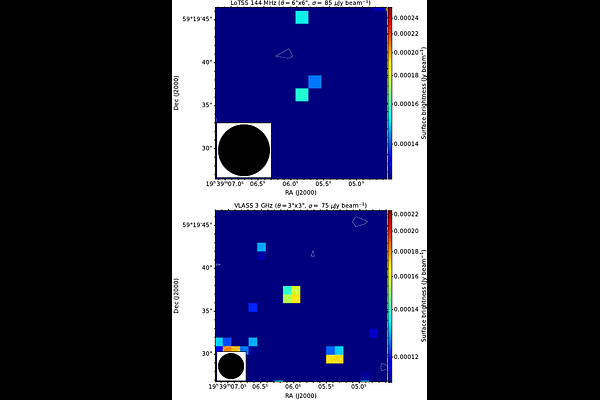
AbstractPersistent radio sources (PRSs) are (sub-)parsec-scale compact non-thermal continuum sources associated with some repeating fast radio bursts (FRBs). Their nature is debated, but their properties provide insights into the FRB environment and progenitors. We measure the spectrum of the recently confirmed PRS associated with FRB 20190417A. Spectral features such as the self-absorption and cooling break can be used to constrain the age and size of PRSs and test theoretical models. We present observations made with the 1.26 GHz upgraded Giant Metrewave Radio Telescope (uGMRT) and observations from the 6 GHz Karl Jansky Very Large Array (VLA). With complementary archival data and the LOw Frequency ARray Two Meter Sky Survey (LoTSS), we characterise the spectrum of the PRS between 144 MHz and 6 GHz. The spectrum follows a power-law behaviour at gigahertz frequencies. The source is not detected at 144 MHz down to a $2σ=170 \; {\rm μJy}$ sensitivity. We modelled the spectrum with a broken power law, obtaining a spectral index $α= 0.20 \pm 0.05$ between 1-6 GHz. We placed a lower limit on the turn-over frequency of $> 370$ MHz ($95\%$ confidence). The flat spectrum and low-frequency turn-over of the target are consistent with the spectral properties predicted for magneto-ionic nebulae, inflated behind the supernova ejecta by a flaring young magnetar. Considering the multi-zone magnetar wind nebula scenario, we estimate an age of $t< 250$ yr and a radius of $R< 0.4$ pc for the target, which would thus be slightly older than the PRSs associated with FRB 20121102A and FRB 20190520B.