A molecular and spatial resource defining tubulin isotype organization during corneal development

A molecular and spatial resource defining tubulin isotype organization during corneal development
Ramarapu, R.; Stoehr, W. R.; Meisen, M.; Border, S.; Thomasy, S.; Rogers, C. D.
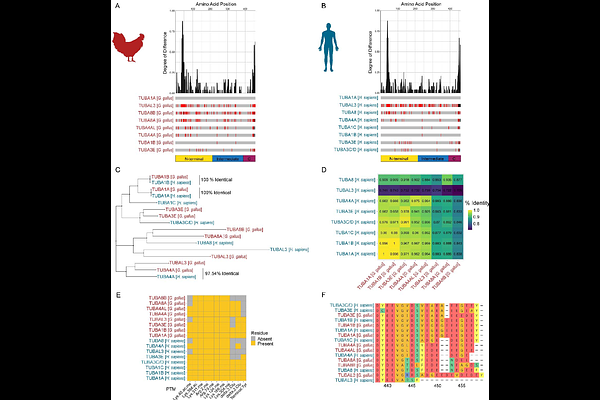
AbstractMicrotubules are essential components of the cytoskeleton that support epithelial organization, polarity, and tissue morphogenesis. They are composed of - and {beta}-tubulin heterodimers, each encoded by distinct genes that generate closely related but functionally distinct isotypes. Although several tubulin isotypes have been implicated in ocular development and disease, how isotype diversity is organized during corneal morphogenesis remains poorly defined. Herein, we use the developing chick embryo as a model system to investigate the conservation and spatiotemporal localization of tubulin isotypes during corneal development. Through comparative amino acid sequence analysis, we show that chick and human - and {beta}-tubulin isotypes are highly conserved at structural and catalytic domains, with divergence concentrated in C-terminal regions associated with post-translational modifications. To relate these molecular features to tissue-level organization, we performed a longitudinal immunohistochemical analysis of five tubulin isotypes across key stages of corneal development. We identify distinct and dynamic patterns of isotype enrichment along apico-basal and central-peripheral axes within the cornea, as well as isotype-specific redistribution during epithelial maturation and corneal endothelial differentiation. Notably, TUBA5/TUBA4A exhibits tightly regulated localization, including enrichment at the leading edge of migratory corneal stromal progenitor cells and within the maturing corneal endothelium. Together, these data establish the chick embryo as a conserved and tractable model for studying tubulin isotype diversity in the cornea, and more broadly across other tissues, and to provide a developmental resource linking tubulin sequence identity to spatially defined microtubule organization during epithelial morphogenesis.