Spatially Resolved Kinematics of SLACS Lens Galaxies. II: Breaking Degeneracies with Lensing and Dynamical Models

Spatially Resolved Kinematics of SLACS Lens Galaxies. II: Breaking Degeneracies with Lensing and Dynamical Models
Shawn Knabel, Tommaso Treu, Michele Cappellari, Simon Birrer, Xiang-Yu Huang, Anowar J. Shajib, William Sheu
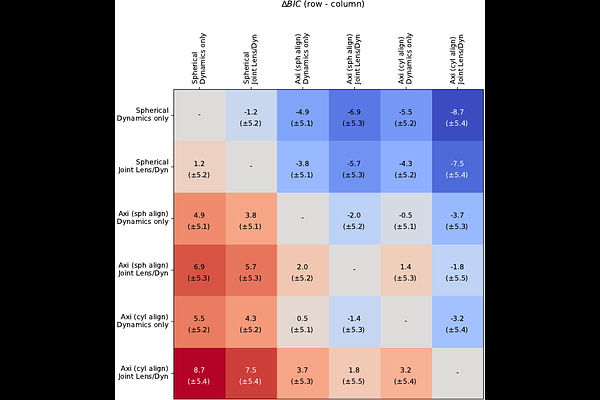
AbstractWe model the dynamical mass density profiles of 14 strong gravitational lens galaxies from the Sloan Lens ACS (SLACS) sample using spatially resolved kinematics obtained from Keck KCWI integral-field spectroscopy. We use the Jeans Anisotropic Modeling (JAM) method, combining 2D kinematic maps with joint constraints from lens models from Hubble Space Telescope imaging. We use informative priors on the anisotropy and intrinsic shape from local galaxies to help break the residual mass-anisotropy degeneracy (MAD). We find nearly isothermal power-law total mass density slopes ($ρ_{\rm tot}\propto r^{-γ}$) for the sample with a mean of $γ= 2.04\pm0.02$ with intrinsic scatter of $0.08^{+0.03}_{-0.02}$. We fit explicitly for deviations from the pure power-law form that are fully sensitive to the mass-sheet degeneracy (MSD) and constrain the value of the mass-sheet parameter $\rm λ_{int}$ for each individual galaxy to an average precision of 5.8%. The mean value of $\rm λ_{int}$ for the sample is $1.01\pm0.03$, with intrinsic scatter of $0.11\pm0.03$. Values of $\rm λ_{int}$ for individual objects and the scatter in the sample are consistent to $1σ$ uncertainty with those found by the Time-Delay COSMOgraphy collaboration's 2025 milestone analysis, which used a spherical analysis of the same dataset, but azimuthally averaged. We thus conclude that on average power-law mass profiles are a good first-order description of the SLACS sample and do not introduce measureable bias in time-delay cosmography. However, our analysis indicates that more flexible mass models should be able to reproduce the highly detailed kinematic datasets more accurately.