Community needs for FAIR pathogen data

Community needs for FAIR pathogen data
van Geest, G.; Thomas-Lopez, D.; Feitzinger, A. A.; Weissgold, L. A.; Halabi, S.; Cuesta, I.; Hjerde, E.; Gurwitz, K. T.; Arora, N.; Neves, A.; Palagi, P. M.; Williams, J. J.
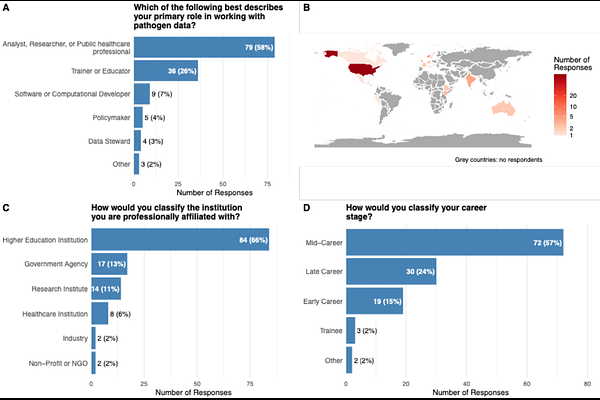
AbstractBackground: Datasets related to infectious diseases are essential for public health decision-making, yet their reuse remains limited by persistent barriers to data sharing and integration. Achieving data that are Findable, Accessible, Interoperable, and Reusable (FAIR) is widely recognized as essential for accelerating scientific discovery and enabling coordinated responses to emerging threats, but the needs of the global pathogen data community have not been systematically characterized. Aim: This study, conducted by the Pathogen Data Network (PDN), aims to identify infrastructural and educational priorities among stakeholders working with infectious disease-related data in order to guide community-responsive support for data sharing and interoperability. Methods: A cross-sectional stakeholder survey was disseminated to a well-defined expert population within PDN networks and via open professional channels. A total of 136 responses from researchers, healthcare professionals, bioinformaticians, and educators were analyzed descriptively to identify prioritized barriers, training needs, and preferred support mechanisms. Results: Respondents consistently identified structural constraints as the primary impediments to effective data use, including limited funding (74%), data-aggregation challenges (68%), and a shortage of skilled personnel (52%). Respondents identified bioinformatics for infectious disease research (68%) as the highest priority for training, followed by guidance on using the integrated pathogen data and tools portal provided by the PDN, the Pathogens Portal (51%). The Pathogens Portal was also ranked as the most essential PDN resource (72%). Preferred training formats included virtual short courses (68%) and webinars (66%). Notably, while researchers emphasized technical subjects like machine learning, educators prioritized foundational case studies. Conclusion: These findings provide an evidence-based diagnostic of community needs and suggest that barriers to FAIR pathogen data are predominantly systemic rather than purely technological. The survey framework and openly available dataset offer a reusable template for assessing needs in other communities and regions. By aligning training, infrastructure development, and outreach with empirically identified priorities, organizations supporting infectious disease research can strengthen the interoperability and reuse of data and establish a benchmark for future community-driven improvements.