An intrinsic decline of accretion activity in GRS 1915+105

An intrinsic decline of accretion activity in GRS 1915+105
Poshak Gandhi U. Southampton, Peter G. Boorman
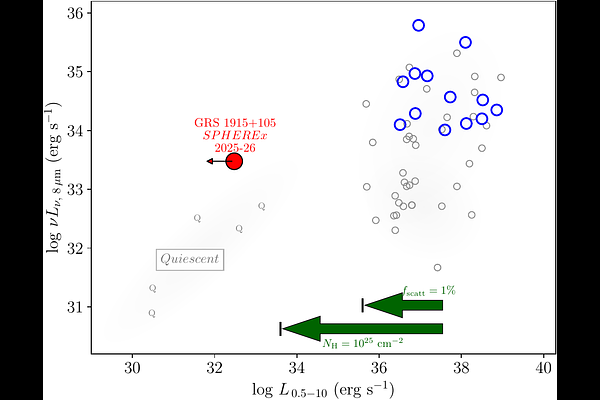
AbstractThe canonical microquasar GRS 1915+105 is exhibiting unprecedented changes in its multiwavelength properties since 2018. Recent pointed observations with NuSTAR in November 2025 have failed to detect the source at flux limits several orders of magnitude deeper than historical X-ray levels. Under an enhanced obscuration scenario, the absence of hard X-rays requires that any obscuring cocoon must be deeply Compton-thick and fully sky covering, with a stringent limit on scattering fractions being less than 1 part in >~10^4, if intrinsic accretion activity continues unabated. An ionised cocoon could also account for a deep radio non-detection in June 2026. But such an interpretation is in conflict with mid-infrared fading of the source observed with SPHEREx in September 2025 and then again in April/May 2026. These facts, together with the source location in the infrared vs. X-ray plane, are consistent with an intrinsic weakening of accretion activity around November 2025 or earlier. We propose that outflows witnessed during intense multiwavelength flaring in 2023-2024 have progressively expelled fueling material from the inner disc, resulting in a significant drop in accretion activity. If correct, the current state gives unique insight into ongoing dramatic secular accretion changes on human timescales. High-frequency resolved radio observations and sensitive infrared or sub-mm observations could test this scenario, and characterise any gaseous cocoon still veiling the source.