Obscured at the Core: Evidence for Nuclear Dust in Reddened Type-1 AGN

Obscured at the Core: Evidence for Nuclear Dust in Reddened Type-1 AGN
Miguel A. Montalvo Hernandez, Andy D. Goulding, Jenny E. Greene
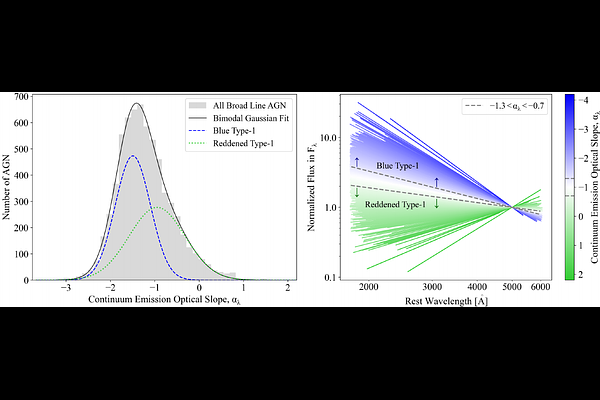
AbstractReddened Type-1 quasars offer a unique window into the structure and evolution of active galactic nuclei (AGN), yet their physical origin and the source of their reddening remain uncertain. Optical surveys often miss these dust-obscured objects, resulting in an incomplete view of the quasar population. In this work, we construct a sample of 6,600 Type-1 quasars at redshifts $0.5 \leq z \leq 1.2$ by combining deep optical imaging from HSC with mid-infrared photometry from WISE, enabling a more complete selection that is not biased against reddened objects. We perform detailed SED modeling using the CIGALE code, enhanced by synthetic photometry derived from SDSS spectra to better constrain the optical continuum. We classify quasars into blue and reddened Type-1 populations based on their continuum slopes and compare their SEDs and emission line properties. As expected from this definition, reddened Type-1 AGN show higher dust extinction, with a median $A_V = 0.60^{+0.32}_{-0.19}$ mag, compared to $A_V = 0.06^{+0.10}_{-0.03}$ mag for blue objects. But they also exhibit smaller torus half-opening angles, with a median of $25.7^{+10.1}_{-8.7}$ deg, compared to $33.3^{+11.1}_{-5.9}$ deg for blue objects. While such extinction could arise on either galaxy or nuclear scales, the systematically stronger narrow-line equivalent widths and weaker Balmer broad lines in reddened Type-1s indicate that the obscuration acts on nuclear scales, likely from dust concentrated near the polar axis. We discuss the possibility that these structural differences may be linked to a sub-pc outflow, that carries dusty gas into the polar region and evacuates the torus region.