Detection of Organics in Water Ice by Optical-PhotoThermal Infrared Spectroscopy

Detection of Organics in Water Ice by Optical-PhotoThermal Infrared Spectroscopy
Christopher S. Duffey, Julie Brisset, Myles Hoskinson, Jakob Haynes, Kathrine Lyakh
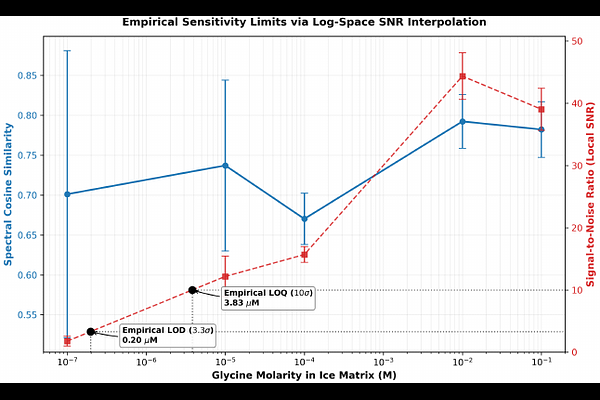
AbstractThe detection and characterization of organic molecules within water ice is vital for interpreting observations of icy moons and comets. However, organic-ice interactions often distort intrinsic water-ice absorption features, complicating infrared (IR) spectral analysis. This study evaluated Optical Photothermal Infrared (O-PTIR) spectroscopy as a non-destructive, sub-micrometer resolution technique to detect and quantify embedded organics. Using a temperature-controlled sample environment to maintain ice stability, frozen mixtures of amino and hydroxy acids were analyzed across a broad concentration range. L-glycine was successfully detected down to approximately $10^{-6}\text{ M}$, yielding an experimental limit of detection (LOD) of $0.2\,μ\text{M}$ and a limit of quantification (LOQ) of $3.83\,μ\text{M}$. Furthermore, O-PTIR measurements of binary mixtures containing L-glycine and lactic acid demonstrated the capacity to differentiate and quantify multiple organic components within a single ice matrix. Notably, a broad absorption feature centered near the water-bending mode appeared exclusively in organic-bearing ice samples and was absent in pure $\text{H}_2\text{O}$ and $\text{D}_2\text{O}$ controls. Comparative analysis in these matrices revealed that embedded organics actively perturb intrinsic ice features, providing new constraints on organic-ice interactions. Ultimately, these results demonstrate that O-PTIR spectroscopy can reliably detect, quantify, and spatially resolve organic compounds in water ice while preserving crucial sample context. The technique offers a promising framework for future laboratory investigations of icy planetary materials and directly informs the interpretation of spectroscopic data from volatile-rich space environments.