Origin of the Fe K$α$ red excess in IC 4329A with XRISM and multi-wavelength spectroscopy

Origin of the Fe K$α$ red excess in IC 4329A with XRISM and multi-wavelength spectroscopy
Misaki Mizumoto, Yuya Nakatani, Satoshi Yamada, Yoshihiro Ueda, Taiki Kawamuro, Shoji Ogawa, Yuto Mochizuki, Kanta Fujiwara, Fumihide Iwamuro, Shogo Otsubo, Noriyuki Matsunaga, Daisuke Taniguchi, Hideyo Kawakita
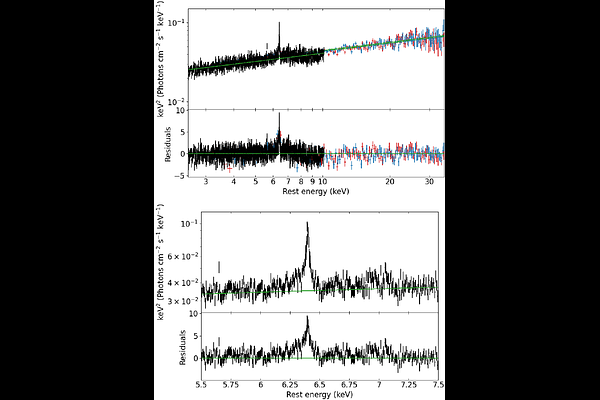
AbstractWe present high-resolution X-ray spectroscopy of the bright local Seyfert 1 galaxy IC 4329A obtained with \textit{XRISM}/Resolve, supported by simultaneous \textit{NuSTAR} data and quasi-simultaneous optical/near-infrared (NIR) spectroscopy. Resolve separates the Fe K$α$ line into a narrow core and a broad component exhibiting a red excess. We examined three scenarios for this red excess: (1) a redshifted X-ray broad line region (xBLR), (2) relativistic disk reflection, and (3) an unshifted xBLR partially absorbed by a mildly ionized absorber. All three models reproduce the X-ray spectra equally well. Our optical (H$β$) and NIR (Pa$β$) spectroscopy shows that the broad lines are redshifted by $v \sim +640\text{--}1050\text{ km s}^{-1}$, close to the solution of the redshifted xBLR model ($v_{\rm shift} = +1700_{-800}^{+1700}\text{ km s}^{-1}$). Motivated by this, we constructed a hybrid model in which the xBLR shares the velocity structure of the optical/NIR BLR and the remaining red excess is attributed to a relativistic disk line, which also provides an acceptable fit. The inferred xBLR radius is $R_{\rm BLR} \sim (3\text{--}6) \times 10^3\ R_g$ ($\sim 12\text{--}22$ light-days). From the narrow Fe K$α$ core in the hybrid model (${\rm FWHM} = 870_{-280}^{+260}\text{ km s}^{-1}$), we estimate a torus distance of $R_{\rm torus} \sim 0.9_{-0.4}^{+1.0}$ pc ($\sim 1100$ light-days), close to the dust sublimation radius. Furthermore, two ultra-fast outflow (UFO) absorption features are identified with $v_{\text{wind}} \sim -0.30c$ and $-0.24c$, both confirmed at $>99\%$ confidence.