Hydroperiod buffers water surface decline in dryland wetlands: A 36-year analysis in Hwange National Park

Hydroperiod buffers water surface decline in dryland wetlands: A 36-year analysis in Hwange National Park
Roy, A.; Alava Baldazo, A.; Hulot, F. D.; SOUDANI, K.
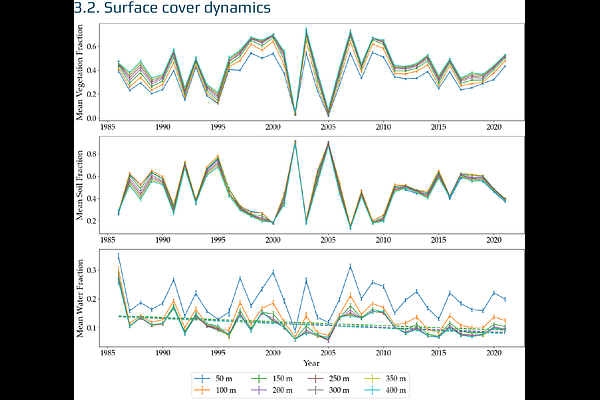
AbstractDrylands are experiencing increasingly intense and frequent drought events due to climate change. Wetlands in drylands are therefore under increasing pressure as their inundation regimes are altered. In southern African savannas, wetlands are often the only sources of free water for the ecosystem. Changes in the hydroperiod may alter vegetation and water surfaces, which could be early signals of desertification in their immediate vicinity. To investigate trends in surface cover around wetlands, we applied linear multispectral unmixing to Landsat pixels located near wetlands in Hwange National Park. We assessed spatial gradients in vegetation, water, and bare soil dynamics from 1986 to 2022. The studied wetlands were also grouped by hydroperiod to test whether the response of each surface cover differed with the reliability of the water resource. Our results show a significant decrease in the water fraction of wetlands with short hydroperiods, which was significantly negatively correlated with increasing temperature. Furthermore, water fraction was significantly positively correlated with vegetation fraction. This correlation suggests that vegetation could be affected if water surfaces continue to decline. Finally, this study is the first to demonstrate a decline in water surfaces in Hwange National Park, with potential implications for wildlife conservation.