Modulation of exploration-avoidance behaviors by vmPFC-projecting BLA neurons

Modulation of exploration-avoidance behaviors by vmPFC-projecting BLA neurons
Huang, H.; Mysore, S.; Adwanikar, H.
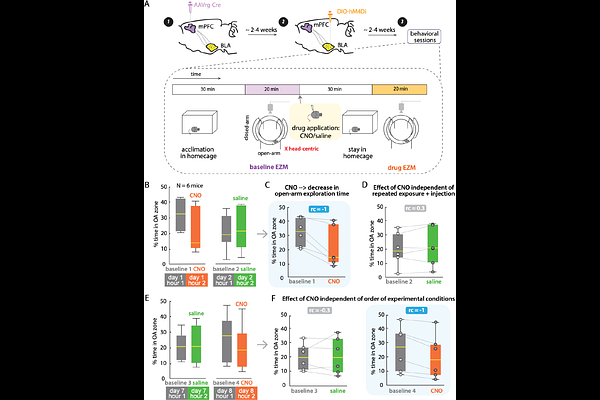
AbstractThe ventromedial prefrontal cortex (vmPFC) is known to regulate exploration-avoidance behaviors. Separately, the basolateral amygdala (BLA), which plays a pivotal role in interpreting the emotional valence of external stimuli, is known to send information about aversive cues to the mPFC. Here, we investigated the role of vmPFC-projecting BLA neurons in modulating exploration-avoidance behaviors. We selectively and reversibly inhibited this subset of BLA neurons using a projection-defined chemogenetic approach in mice engaged in a classic unconditioned exploration-avoidance task, the elevated zero maze (EZM). Saline injection served as a control for administration of the chemogenetic ligand CNO. We found that inhibiting vmPFC-projecting BLA neurons with CNO injections promotes avoidance behaviors. This effect could not be attributed to the effects of injection. It could also not be attributed to repeated maze exposure because, whereas we observed behavioral habituation in naive mice following repeated exposure at 1 hr, in mice mimicking treatment manipulation (IP injection), no habituation was observed at this timepoint. Together, our results reveal that vmPFC-projecting BLA neurons promote safety rather than aversive signals in the context of unconditioned exploration-avoidance behavior. Surprisingly, these findings are directly opposed to previous work that suppressed BLA projection fibers in the mPFC. These contrasting results suggest pathway-dependent roles of mPFC-projecting BLA neurons (direct axonal vs. complex somatic, due to direct + indirect), or alternatively, specializations in the roles of mPFC subregions (vmPFC vs. dmPFC) in exploration-avoidance behavior. Our results also provide guidance for future experimental designs involving repeated exposure to the EZM.