Oxaliplatin Induces Spontaneous Firing at Sensory Endings Across Touch and Proprioceptive Afferents

Oxaliplatin Induces Spontaneous Firing at Sensory Endings Across Touch and Proprioceptive Afferents
Nardelli, P.; Reed, J.; Vincent, J. A.; Vitali, G. A.; Bui, K. C.; Housley, S. N.; Cope, T. C.
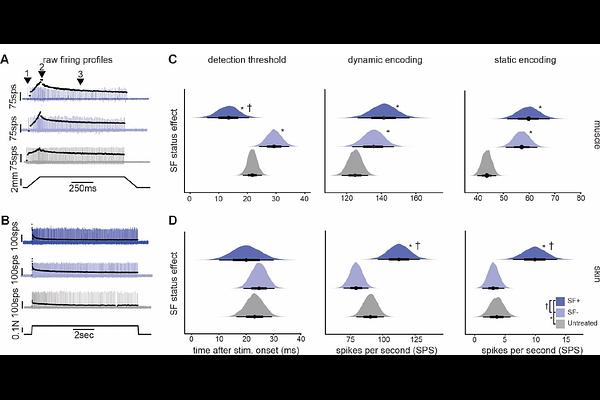
AbstractSpontaneous activity in primary sensory neurons has been implicated in neuropathic symptoms, yet its earliest origins and immediate functional consequences remain incompletely understood. This gap is especially consequential in chemotherapy-induced peripheral neuropathy (CIPN), where sensory toxicities commonly limit effective cancer treatment. Using in vivo recordings in rats, we show that a single dose of oxaliplatin (OX) induces spontaneous firing within 24 h across touch and proprioceptive low-threshold mechanoreceptor (LTMR) afferents. Spontaneous firing consistently originated distally in peripheral axons and was accompanied by enhanced responses to mechanical stimulation, identifying LTMR sensory endings as the earliest source of spontaneous firing and a common site for spontaneous and stimulus-evoked hyperexcitability. OX also induced early structural abnormalities at sensory endings; however, SF+ LTMRs retained mechanosensory response profiles, indicating that spontaneous firing can emerge within otherwise functional sensory endings. Although coincident spontaneous and stimulus-evoked activity distorted encoding in individual LTMRs, these effects had little impact on population LTMR responses or motor behavior relying on mechanosensory feedback. Together, these findings identify sensory endings as an early target of OX neurotoxicity and demonstrate that spontaneous firing spanning multiple tactile and proprioceptive LTMR submodalities can coexist with largely preserved sensory function, indicating that even broad engagement across mechanosensory pathways is insufficient to disrupt all LTMR-dependent functions. These observations indicate that abnormal afferent activity initiated at sensory endings may be sufficient to engage sensory pathways underlying some paresthetic symptoms while leaving others largely unaffected, whereas progression to chronic neuropathic symptoms may require subsequent recruitment of the dorsal root ganglion.