Mechanochemical coupling tunes robustness of PAR polarity across developmental contexts in the C. elegans embryo

Mechanochemical coupling tunes robustness of PAR polarity across developmental contexts in the C. elegans embryo
Saito, R.; Lee, S. S.; Nishikawa, M.
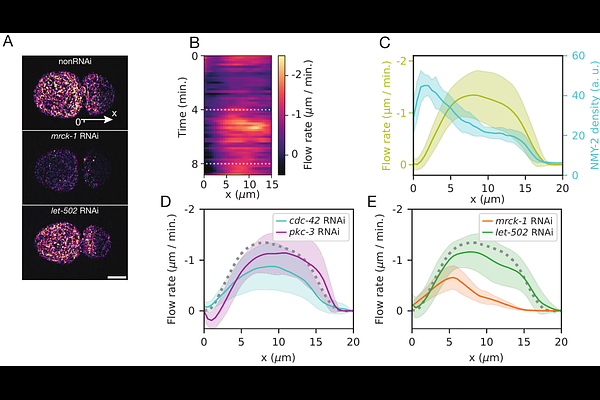
AbstractProper establishment of cell polarity is essential for reliable asymmetric divisions during embryonic development. In the Caenorhabditis elegans zygote, polarity is established through mechanochemical coupling between advective transport driven by cortical flows and mutually antagonistic PAR protein interactions. How these mechanisms are integrated across developmental contexts to establish cell polarity in the early embryo remains unexplored. Here we show that P1 polarization relies primarily on sustained antagonistic activity of anterior PAR proteins mediated by CDC-42 and PKC-3. Cortical contractility is regulated by CDC-42 through MRCK-1 to drive cortical flow, and is largely independent of the RHO-1 -- LET-502 pathway that is crucial in zygotic polarity establishment. We find that these flows contribute only weakly to P1 polarity and primarily during the late phase. P1 polarization is sensitive to CDC-42 dosage, as indicated by reduced cytoplasmic asymmetry of MEX-5 and loss of division asynchrony between daughter cells. In contrast, zygotic polarization remains robust to comparable perturbations in CDC-42 expression when cortical flow is intact, but becomes sensitized when cortical flow is suppressed. Together, these findings show that cortical flow acts as a transport-mediated reinforcement that buffers PAR polarity against perturbations in CDC-42 expression, and that weakening this reinforcement sensitizes polarity establishment across developmental contexts.