Single-particle light scattering reveals the dynamic heterogeneity of biomolecular condensates

Single-particle light scattering reveals the dynamic heterogeneity of biomolecular condensates
Rodriguez, B. G.; Makasewicz, K.; Tesei, G.; Arosio, P.; Volpe, G.; Midtvedt, D. S.
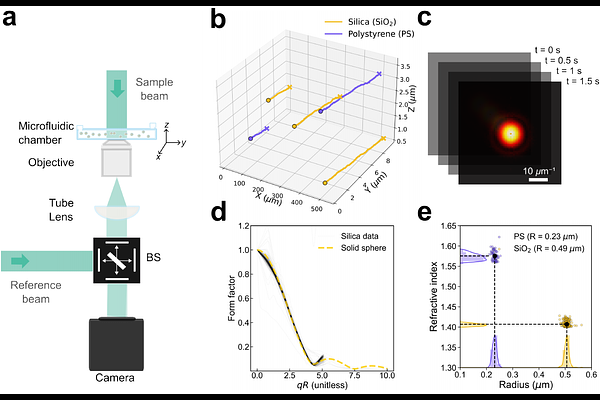
AbstractBiomolecular condensates are membraneless cellular compartments that form through weak, multivalent interactions. These condensates are typically submicrometer structures whose biological functions depend sensitively on physical properties such as size, composition, internal concentration and interfacial properties. Despite recent progress in characterizing these systems, high-throughput, label-free, and quantitative measurements of these parameters at the single-condensate level and at submicron length scales are lacking. Here, we employ an off-axis holographic imaging technique to simultaneously quantify the size, protein concentration, interfacial structure, and hydrodynamic drag of submicrometer condensates formed by the N-terminal domain of Ddx4 and synthetic polymers, with a throughput of hundreds of condensates per minute. We find that Ddx4-LCD forms two morphologically distinct classes of condensates: one class with a sharp interface and another with a broad interface. The relative abundance of these classes changes in response to ionic strength and as a function of time, revealing a dynamic heterogeneity even in single component condensates. By characterizing condensates formed by zwitterionic polymers, we show that the presence of two populations can be reproduced in systems with two types of stickers, but not in systems with one sticker type. Our results reveal that, while obscured in ensemble-based or monoparametric measurements, chemically identical systems at the molecular level can encode multiple coexisting condensate states at the mesoscale, arising from heterogeneity in interaction motifs. These findings identify interaction heterogeneity as a key factor governing interfacial organization in multivalent condensates.