Rapid and robust sex determination from ancient enamel proteomes using protSexInferer

Rapid and robust sex determination from ancient enamel proteomes using protSexInferer
Bai, F.; Wu, Z.; Xing, S.; Fu, Q.
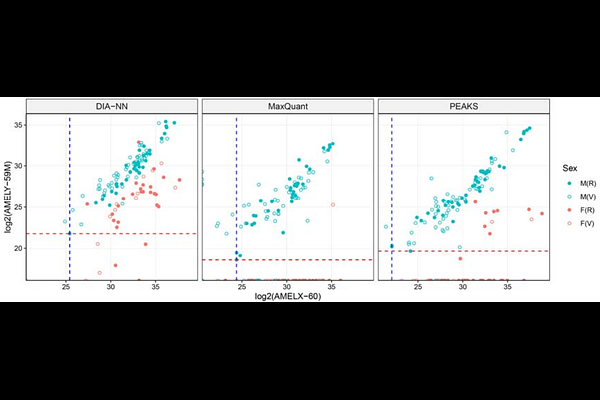
AbstractAccurate biological sex determination of ancient remains is critical for archaeological, anthropological, and forensic studies, but remains challenging for morphologically ambiguous and highly degraded endogenous DNA samples. Paleo-proteomics sex identification approaches, targeting sexually dimorphic amelogenin isoforms (AMELX and AMELY), present a promising solution. However, current workflows rely on manual verification of a few specific peptide markers, a process that lacks standardization and is susceptible to false-positive AMELY signals. To overcome these limitations, we developed protSexInferer, a lightweight, open-source bioinformatic pipeline for automated sex estimation from paleo-proteomic data. Our method uses the ratio of AMELY-specific peptides to all detected AMELY- and AMELX-specific peptides (i.e., the RAMELY value) rather than the mere presence or absence of AMELY signals for sex classification. We demonstrated that the RAMELY value clearly distinguishes male and female individuals in both reference and independent validation datasets, enabling reliable sex assignments even in cases where conventional intensity based comparisons (e.g., AMELY-59M vs. AMELX-60) are ambiguous. This ratio-based approach effectively mitigates the impact of false-positive AMELY signals, therefore eliminating the need for time-consuming manual verification, and remains reliable even for samples with low peptide yields. Equipped with pre-constructed protein reference databases, protSexInferer provides a robust, standardized, and end-to-end solution for paleo-proteomic sex determination.