Global Patterns and Drivers of Bee Diversity and Endemism on Islands

Global Patterns and Drivers of Bee Diversity and Endemism on Islands
Marshall, L.; Ascher, J. S.; Whittaker, R. J.; Orr, M. C.; Hughes, A. C.; Schrader, J.; Weigelt, P.; Kreft, H.; Vereecken, N. J.
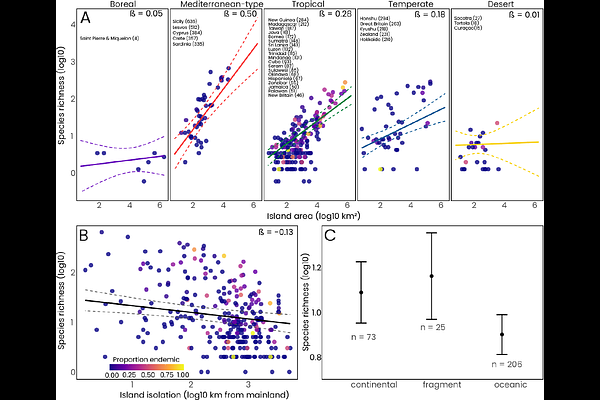
AbstractIslands harbor a disproportionate share of global biodiversity1, yet insects, even invaluable pollinators such as bees2, remain underrepresented in island biogeography research3. Here, we present the first global checklist of island bees, recording 4,140 species across 306 islands. Although islands comprise only ~5% of Earth's land area, they support ~20% of global bee diversity, and 43% of insular species are endemic, making up ~8% of all known bee species. Island bee species richness, mirroring continental trends4, peaks at mid-latitudes. Native richness increases with island area and declines with isolation, consistent with patterns in other taxa5. The strength of species-area relationships varies among biomes and is steepest in mediterranean-type systems, which also support disproportionately high bee richness relative to flowering plant diversity. Endemism is highest on large tropical islands, reflecting extensive in situ diversification. Major centers of bee endemism include Madagascar, Malesia (e.g. the Greater Sundas and New Guinea), and Hawai'i, where a single large radiation of Hylaeus (Nesoprosopis) dominates6. Among islands capable of supporting endemic species, endemism scales strongly with total richness. These findings highlight the need to integrate island bee diversity into global conservation planning and position bees as a model for understanding insect evolution and conservation on islands.