The Great Escape of ionizing photons during Cosmic Morning

The Great Escape of ionizing photons during Cosmic Morning
Kanak Saha, Roland Bacon, Anne Verhamme, Soumil Maulick, Akio Inoue, Souradeep Bhattacharya, Marc Rafelski, Edmund Christian Herenz, Rogier Windhorst, Michael Rutkowski, Shyam N. Tandon
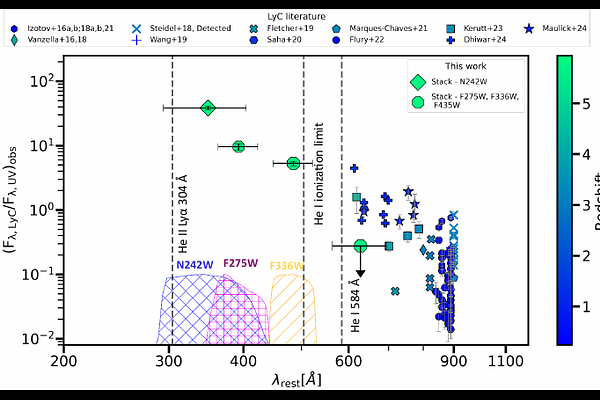
AbstractThe end of the Cosmic Dark Age marked the onset of reionization, driven by extreme-UV photons from the first galaxies. Direct detection of such photons has remained challenging due to strong intergalactic attenuation. Here, we report the first direct detection of ionizing photons at rest-frame wavelengths $350Å$, $392Å$, and $485Å$, using deep UV imaging from two independent space observatories: AstroSat and HST. These photons emerge from a stacked sample of spectroscopically confirmed Ly$α$ emitters at $5.9<z<6.0$ in the Hubble Ultra Deep Field identified with VLT/MUSE and JWST/NIRSpec. These detections imply a higher transparency of the interstellar and intergalactic media to ionizing radiation than predicted by current models. The stacked spectrum, representative of faint galaxies with $M_{\mathrm{UV}}=-18.77\pm0.05$ ($\sim0.1L^{\ast}$), exhibits a hard slope ($-2.3\pm0.1$) and produces ionizing photons with $\text{log}_{10}ξ_{\text{ion}}^{true}$ = $25.86 \pm 0.02$ Hz erg$^{-1}$ and escape fraction $f_{esc}\simeq 0.8$. Individual measurements reveal very blue UV continua ($β\leq -3$) for three galaxies), young ages ($< 6$ Myr for four), and low metallicities ($Z \sim 0.02 - 0.05\ Z_{\odot}$ for two), indicating the possible presence of very hot, massive stars capable of producing enough ionizing photons to drive cosmic reionization, thereby providing new constraints on its sources. Furthermore, detection of photons with energies $>24.6\ $eV provide evidence that HeI reionization has begun by this epoch.